
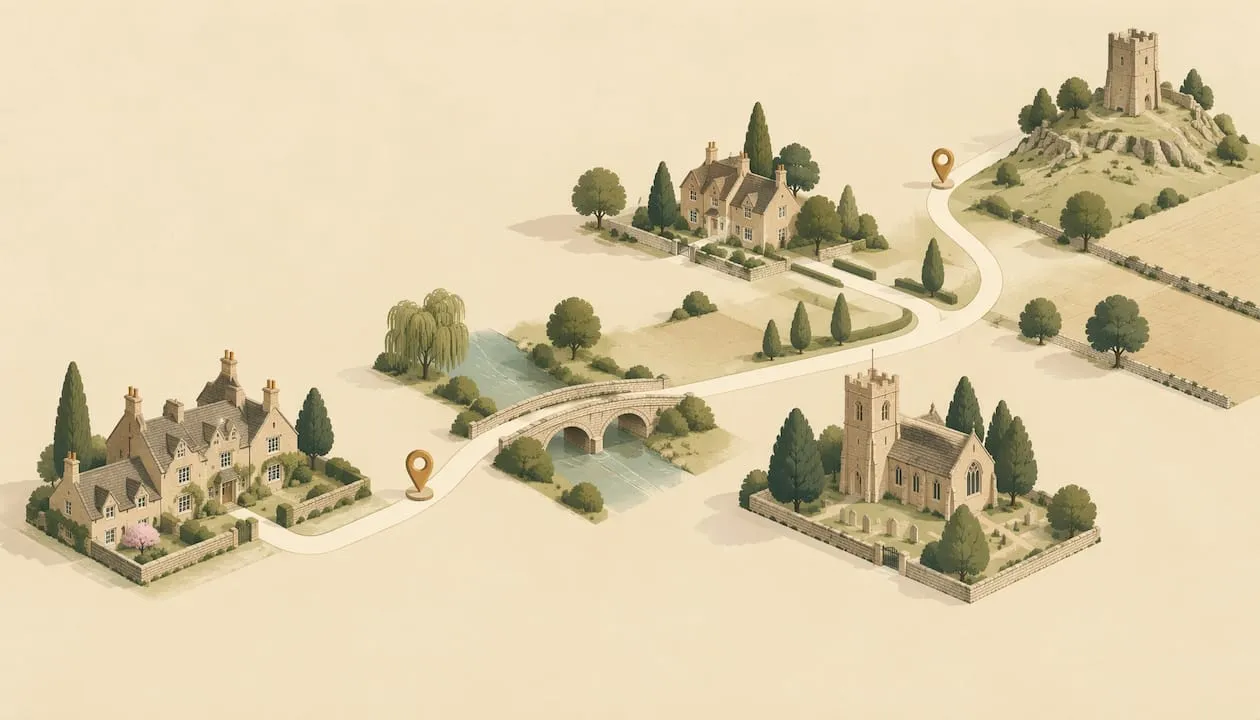
One Day in the Cotswolds: A Realistic Driving Itinerary
9 November 2026Last checked 9 November 2026
One day in the Cotswolds is enough for a happy, unhurried taste of the region, as long as you choose a small patch and resist the urge to tick off everything. Aim for three or four villages, a stretch of quiet back road and a proper pub lunch. This guide gives you a northern route you can drive, the order that avoids doubling back, a quieter swap in the south, what changes in winter and what to do differently if you start from London.
TL;DR
- Pick one corner of the Cotswolds, north or south, and stay in it. Three or four stops is a full day.
- A good northern loop runs Bibury, Burford, a pub lunch on the A40, Bourton-on-the-Water and Stow-on-the-Wold, with Chipping Campden or Broadway as an optional finish. The drives between stops are short, roughly 5 to 20 minutes each.
- Choose your lunch pub first and check its hours, then build the day around it.
- Start early. The best-known villages are calmest in the morning.
- Between November and February the sun sets between about 4pm and 5.45pm, earliest in late December, so plan a shorter day and finish before dark.
Table of Contents
- Is one day enough for the Cotswolds?
- Choose your corner first: north or south
- A one-day northern Cotswolds driving route
- A southern alternative: a quieter loop
- Starting from London: how the day changes
- Best time of year for a day in the Cotswolds
- What a day in the Cotswolds costs
- Plan your day with the app
- Making the day work for different travellers
- Practical tips before you set off
- Sources
Is one day enough for the Cotswolds?
It is enough for a good day, not for “the Cotswolds”. The region is a long stretch of limestone hills and hundreds of villages, and the lanes between them are narrow, winding and slower than the map suggests. Every extra village adds parking, a short wander and a drive, so the day shrinks quickly.
A realistic one-day shape looks like this:
- Three or four villages or small towns, each given 45 minutes to an hour and a half.
- One stretch of quiet back road, driven slowly, so the day is not only streets and shops.
- One long lunch, ideally in a village pub.
- Some slack for the view, café or church you did not plan for.
Give your favourite place on the route the most time, up to a couple of hours, and the others less. A day with three well-chosen stops is usually better than one with seven rushed ones.
If you find yourself wanting more, our two-day short-drive itinerary for the north and the slower three-day route from London pick up where this one ends.
Choose your corner first: north or south
The single best decision you can make is to commit to one area. Castle Combe, in the south, is more than 50 miles by road from Chipping Campden, in the north, well over an hour each way, so hopping between the two turns a gentle day into a long drive.
| Northern Cotswolds | Southern Cotswolds | |
|---|---|---|
| Feel | Classic honey-stone villages, market towns, rolling farmland | Steeper valleys, woodland, market towns, quieter lanes |
| Typical stops | Bibury, Burford, Bourton-on-the-Water, Stow-on-the-Wold, Chipping Campden, Broadway | Castle Combe, Tetbury, Cirencester, Painswick |
| Best for | First visits, photographs, village-hopping | Walkers, slower days |
| Pace | Short hops between stops | Longer drives between stops, more scenery between |
If it is your first time and you want the picture-postcard Cotswolds, take the north. If you prefer wooded valleys and a slower pace, take the south, and start the day at Castle Combe.
A one-day northern Cotswolds driving route
This loop runs south to north without doubling back, and gets the two busiest stops, Bibury and Bourton-on-the-Water, either early or after lunch. The drive times below are approximate, from the OSRM route planner in clear traffic; allow longer on narrow lanes, behind farm vehicles and on summer weekends. The clock times are a guide for a day starting at 9am: adjust them to how long you linger.
Morning: Bibury, then Burford
Bibury at about 9:00. Arlington Row sits beside the River Coln. The National Trust says the terrace was probably built around 1380 as a monastic wool store and was converted into weavers’ cottages in the 17th century. The cottages are people’s homes and are not open to visitors, so keep voices low, stay on the paths and take your photographs from the public side. Half an hour to 45 minutes by the river is plenty. Parking is limited: the National Trust points visitors to the roadside spaces and the parking opposite the trout farm, the trout farm’s own car parks charge, and Gloucestershire County Council has been tightening parking in the village, so read the signs on the day.
Burford at about 10:00, about 10 miles and 15 minutes east on the B4425. The High Street runs steeply downhill to the River Windrush, lined with old stone shopfronts, and it is far more pleasant before the late-morning crowds. West Oxfordshire District Council’s Guildenford car park is free, with time limits on the bays, and fills up at busy times. Walk down to the bridge, look into the church if it is open and have a coffee. The Burford guide lists cafés, shops and pubs.
Lunch: a pub in the Windrush valley
Lunch at about 12:00. Rather than eating in the busiest village, choose a pub a short drive away. The Inn for All Seasons, a coaching inn on the A40 near the Barringtons, about three miles west of Burford, is one place listed in our guide that sits on this route. Whichever pub you choose, check its opening hours and whether the kitchen takes bookings before you set off. Many village pubs stop serving in the middle of the afternoon, keep shorter hours in winter, and a Sunday lunch can fill up days ahead.
Afternoon: Bourton-on-the-Water and Stow-on-the-Wold
Bourton-on-the-Water at about 13:30, about 11 miles and 15 to 20 minutes from the A40. The River Windrush runs shallow through the centre under a series of low stone footbridges, which is why the village is sometimes called the Venice of the Cotswolds. It is lively, so expect company. Head for Cotswold District Council’s Rissington Road car park on the edge of the village rather than looking for a space in the centre. Walk the riverside and move on after an hour or so. The Bourton-on-the-Water guide covers the rest.
Stow-on-the-Wold at about 14:45, about 4 miles and 10 minutes north. Stow sits on a hilltop where several old roads meet, with a large market square, antique shops and narrow alleys between the buildings. The council’s pay-and-display car park is on Maugersbury Road. It is a good place to browse, buy something small to take home and stretch your legs. See the Stow-on-the-Wold guide.
Late afternoon: Chipping Campden or Broadway
If there is daylight left, finish at about 16:00 in Chipping Campden, about 10 miles and 15 to 20 minutes from Stow, whose curving High Street of golden stone and 17th-century Market Hall reward a slow walk. Broadway is the alternative, about 12 miles and around 20 minutes from Stow. Parking in both is limited, so check the signs for time limits. Leave time for a last cup of tea before the drive home. The Chipping Campden and Broadway guides list places to eat.
In winter this last stop arrives at dusk, so either drop it and end at Stow or skip one of the earlier stops. If you want more fresh air in any season, swap one of the afternoon stops for a short walk on a public footpath.
A southern alternative: a quieter loop
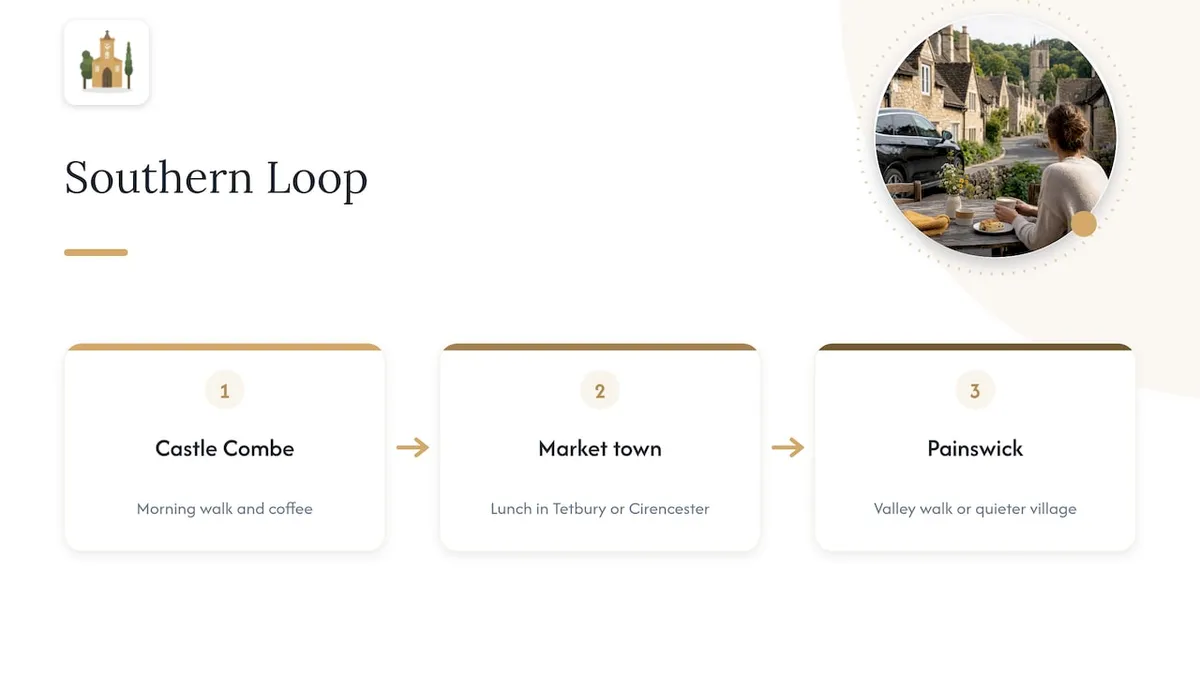
If the north’s crowds do not appeal, a southern day suits slower travellers, though the drives between stops are longer. Start at Castle Combe in the morning, when the cottages and the stream through the village are at their stillest. The village car park is pay-and-display and sits above the village, and the lane down has no pavement in places, so take care. Walk the lane by the river, look at the Market Cross and the church, and have a coffee. Our Castle Combe page shows places nearby.
From there, drive to Tetbury, about 16 miles and 25 minutes, for lunch and a stroll through the market streets, then on to Painswick, about 14 miles and 30 minutes, for its churchyard and a gentle walk in the valleys around it. Cirencester works instead of Tetbury but adds about a quarter of an hour of driving to the loop. You will cover less ground and, outside the middle of the day at Castle Combe, see fewer people. The Tetbury, Cirencester and Painswick guides list places to eat, and our other area guides group things to do by the place you are near.
Starting from London: how the day changes
From London, the Cotswolds are doable in a day, but the journey eats into your hours. The more you try to see, the less you will actually enjoy.
- Keep to one village cluster. Take the northern loop above but cut it to two or three stops and a lunch, or take the southern route and stop at two places.
- Leave early and come home before the evening rush. An early start gives you calmer villages; an earlier return avoids driving tired on country lanes.
- Decide car or public transport before anything else. A car gives you the freedom to reach small villages and viewpoints. Without one, base the day on a single village or market town and the walks from it.
Our full guide covers this exact question: a Cotswolds day trip from London by train, car or coach. If you would rather not rush at all, the three-day slow itinerary is built for people coming from the capital.
If you are starting nearby, you have the advantage: you can choose the quiet hours, go midweek and finish with a pub supper rather than a long drive back.
Best time of year for a day in the Cotswolds
There is no wrong season, only different days. Our season-by-season guide goes into more detail.
- Spring: blossom, lambs and fresher mornings. A good time for walking.
- Summer: long light, gardens at their best and the busiest villages. Start early and keep the most popular stops for the morning.
- Autumn: turning beech woods and fewer visitors than in summer.
- Winter: quiet lanes, log fires and a cosy lunch. Days are short: around the shortest day the sun rises after 8am and sets before 4pm, so a 9am start gives you about seven hours of daylight. Plan to finish in daylight and allow for frost and mud on back roads.
Whatever the month, check opening hours before you go. Smaller shops, tearooms and some pubs keep shorter hours outside the summer, and many gardens and historic houses close or open only on certain days in winter. None of the stops on the northern or southern loop above depends on a paid attraction, so both work all year. Weekdays are calmer than weekends, and bank holiday weekends are the busiest of all.
What a day in the Cotswolds costs
The Cotswolds can be as modest or as indulgent as you like, because much of it is free: village streets, riverside paths, churchyards and views. The costs that add up are the ones you can plan for.
- Parking: it varies by council and village. On the northern loop, Burford’s Guildenford car park is free, Bibury’s spaces are limited and the council has been tightening the rules there, and Bourton’s and Stow’s council car parks charge. Rates and payment methods change, so check the council’s website or the machine on the day rather than trusting an old figure.
- Food and drink: a pub lunch is the biggest single cost. Look at menus in advance and decide whether you want a full sit-down meal or a lighter plan, such as a bakery picnic on a bench by the river.
- Attractions: gardens, houses and model villages charge admission, and some have timed entry. One paid attraction at most is plenty for a single day.
- Extras: an ice cream, a postcard, a small gift from a village shop.
A good rule is to spend your money on lunch and one memorable thing, and let the villages be free.
Plan your day with the app
Every village and town named here is listed in The Cotswolds App, alongside thousands of other places across the region. Our listings are built from open data and published only after review, so treat them as a starting point and check opening times with the venue.
- On the interactive map you can switch categories on and off, so a layer of pubs, cafés or parking sits over the villages on your route.
- In the directory you can narrow places by category and to those within a set distance.
- Near me shows what is close if a plan falls through or a car park is full, and Driving mode lists places around and ahead of the car for a passenger to read. It is not for the driver.
- Sign in and you can save your stops into an itinerary, with driving routes between them and a link out to Google or Apple Maps, and download the directory and maps for offline use before you lose signal.
Where visitors have left reviews, a place page shows a sheep rating, an accessibility rating and a dog-friendly rating. Those ratings are for reading only: you cannot narrow the map or the directory by them, and many places have no reviews yet. You can also install The Cotswolds App on your phone before you go.
Making the day work for different travellers
The same route flexes depending on who is in the car.
- Families: choose one main activity and let the rest be easy. Our guide to family days out in the Cotswolds explains how to build a day around it, and our family things to do page gives more ideas.
- Couples: pick quieter villages and a long lunch. Our romantic Cotswolds guide suggests places for it.
- Walkers: swap a village for a footpath. A loop of an hour or two from a village car park gives you views away from the busiest streets.
- Food lovers: make lunch the destination and choose the village around it.
- Drivers who want the road itself: our scenic drives guide has routes built around the drive.
Practical tips before you set off
- Download what you need. Mobile signal can be patchy in the valleys, so save your map and key stops before you leave.
- Fill the tank before you set off. It is one less thing to find on the lanes.
- Drive gently. Lanes are narrow, with walls and hedges close to the road. The Highway Code asks drivers on country roads to slow down for bends, horses, cyclists and pedestrians, and to use passing places on single-track roads.
- Stop safely. If a view catches you, pull into a lay-by or car park, never a field gateway or a passing place.
- Respect the villages. People live here, so stay on public paths, keep dogs on a lead near livestock and take your litter home.
- Pack for changing weather. A light waterproof and comfortable shoes are worth more than a perfect outfit.
Sources
Opening hours, parking arrangements and charges change, so confirm the details for your dates before you travel. Drive times and distances are approximate, from the OSRM route planner in clear traffic.
- Bibury and Arlington Row — National Trust
- Bibury Traffic Management Plan — Gloucestershire County Council
- Free parking continues as stay times change in Burford — West Oxfordshire District Council
- Car parking locations and prices, including Bourton and Stow — Cotswold District Council
- The Highway Code, rules 154 and 155 (country roads and single-track roads) — GOV.UK
- OSRM open-source route planner (drive times)