
Two Days in the Cotswolds: A Short-Drive Itinerary for the North
12 October 2026Last checked 12 October 2026
In two days you can see the heart of the north Cotswolds by basing yourself in Stow-on-the-Wold, or in Moreton-in-Marsh if you are arriving by train, and keeping to two tight clusters: Day 1 runs from Stow through the Slaughters to Bourton-on-the-Water, and Day 2 covers Broadway, Broadway Tower and Chipping Campden. Bibury is the obvious extra, but it sits well south of the Day 2 villages, so it fits better at the end of Day 1 than as an afternoon add-on to Day 2.
TL;DR:
- Arrive before 10am in peak season, because village car parks fill early; in Bourton-on-the-Water, the council’s Rissington Road car park on the edge of the village saves circling the centre.
- Drivers have the most choice of rooms in and around Stow; rail arrivals should base themselves at Moreton-in-Marsh, which has direct trains from London Paddington and is where the Pulhams 801 bus starts.
- Without a car, the 801 runs hourly, seven days a week, from Moreton to Stow and Bourton, but Chipping Campden and Broadway have buses on weekdays only.
- Bibury is roughly 25 miles by road from Chipping Campden, the best part of an hour each way, but only about 12 miles from Bourton, so add it to Day 1 if you add it at all.
- Allow 45 minutes to an hour at Broadway Tower itself; the circular walk up from Broadway village is about four miles and takes two and a half to three hours.
Table of Contents
- Your 2-day Cotswolds itinerary at a glance
- Day 1: Stow-on-the-Wold, the Slaughters and Bourton-on-the-Water
- Day 2: Broadway, Broadway Tower and Chipping Campden
- Choosing where to base yourself overnight
- Getting to and around the Cotswolds
- Practical notes worth knowing before you go
- What to pack for a 2-day Cotswolds trip
- Pacing your two days
- Planning this loop with The Cotswolds App
- Sources
Your 2-day Cotswolds itinerary at a glance
This north-Cotswolds plan keeps you within a small area, so you spend your time in the villages rather than on the road. Day 1 is about riverside villages and an easy walk; Day 2 trades the water for the escarpment views and the stone High Streets of Broadway and Chipping Campden.
Day 1: Stow-on-the-Wold, the Slaughters, Bourton-on-the-Water
- Stow-on-the-Wold: an hour or two around the market square, the antiques shops and St Edward’s Church.
- Lower and Upper Slaughter: about an hour for the walk between the two and back.
- Bourton-on-the-Water: an hour and a half to two hours, longer with children.
Day 2: Broadway, Broadway Tower, Chipping Campden
- Broadway: an hour or so for the High Street.
- Broadway Tower: 45 minutes to an hour at the top, or a half-day if you walk up from the village.
- Chipping Campden: an hour and a half to two hours for the High Street, the Market Hall and lunch.
The drives between stops are short. By our estimates from the map, none of the legs on Day 1 is more than about ten minutes, and on Day 2 the longest is the run from a Stow base to Broadway, roughly 12 miles or about 25 minutes. Bibury is the exception, which is why it is optional.
Day 1: Stow-on-the-Wold, the Slaughters and Bourton-on-the-Water
Start in Stow-on-the-Wold around 9 to 9.30am, while the market square is still quiet. Stow sits on a hilltop where several old roads meet, and its square is ringed with independent shops, antiques dealers and cafés. Give it an hour or two: long enough for coffee, a wander round the square and a look at St Edward’s Church, whose north door is framed by two yew trees growing hard against the stonework. The guide to Stow-on-the-Wold lists places to eat and shop, and things to do in Stow-on-the-Wold goes into more detail.
From Stow it is about three miles to Lower Slaughter, where the River Eye runs shallow beside the lane under low stone footbridges. Parking in Lower Slaughter is scarce, so either arrive early or park once in Bourton-on-the-Water and walk out across the meadows to Lower Slaughter, 25 to 30 minutes each way. The path from Lower to Upper Slaughter follows the river along the Warden’s Way: about a mile each way, 20 to 25 minutes at an easy pace, level but muddy after rain. Upper Slaughter is quieter still, with no shops, which is much of its appeal.
- Arrive in Stow by 9.30am and spend an hour or two in the square and church.
- Drive the three miles to Lower Slaughter, or on to Bourton and walk out from there.
- Walk the riverside path to Upper Slaughter and back, about an hour in all.
- Spend the afternoon in Bourton-on-the-Water, a couple of miles south.
Bourton-on-the-Water is the busiest village on the route, and the crowds are heaviest in the middle of the day, so a late afternoon visit is the calmer choice. The River Windrush runs shallow through the centre under a series of low footbridges, and you can easily fill an hour and a half to two hours here. With children, The Model Village and Birdland Park and Gardens can each stretch the visit further. Head for the Rissington Road car park on the edge of the village rather than looking for a space nearer the centre. The Bourton-on-the-Water guide covers the rest.
For lunch, eat in Stow or the Slaughters rather than in Bourton at midday, and keep Bourton’s riverside cafés for tea later on. In the evening, a pub supper near your base is the natural end to the day; booking ahead is wise in summer.
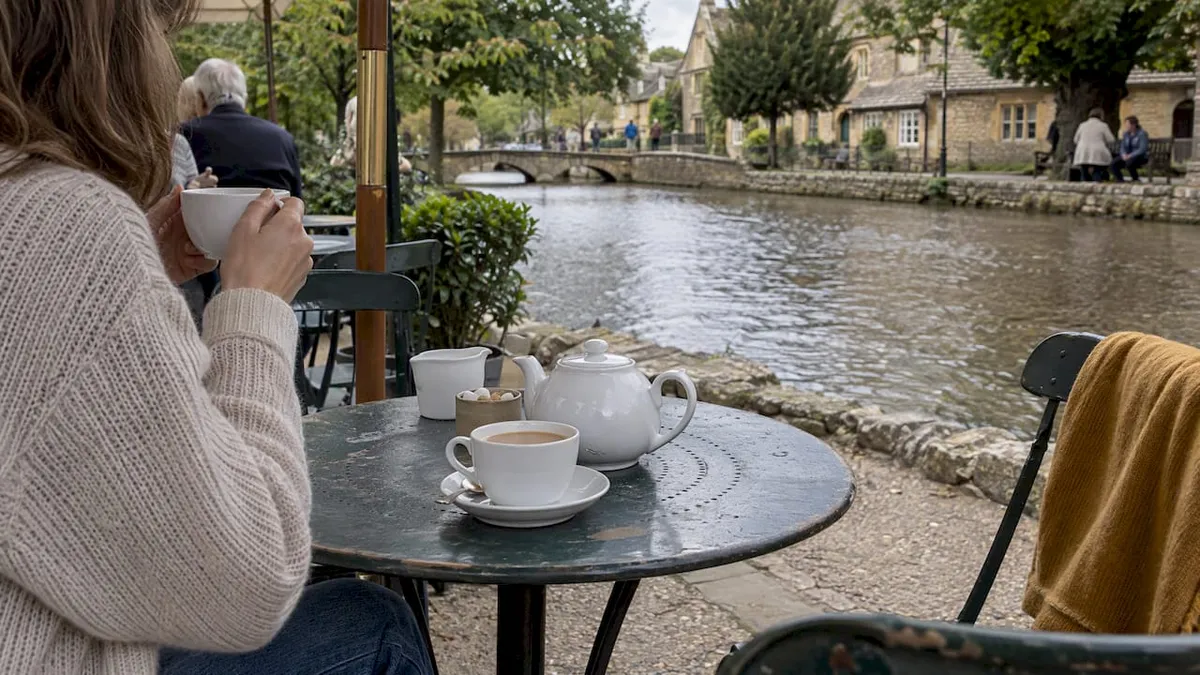
Optional extra: if you have the energy for one more stop, Bibury is about 12 miles south of Bourton by road, roughly half an hour by our estimate. Arlington Row began as a monastic wool store around 1380 and became weavers’ cottages in the 17th century; it is owned by the National Trust and seen from the lane across the water meadow. Late afternoon is noticeably calmer than the middle of the day, and since May 2025 Gloucestershire County Council has closed the village’s coach bays on a trial basis.
Day 2: Broadway, Broadway Tower and Chipping Campden
Aim to be parked in Broadway by around 9.30am, before the day-trip traffic builds. Broadway’s wide High Street, with grass verges along it, feels more open than the valley villages, and an unhurried walk along it with a stop for coffee takes about an hour. Our Broadway guide covers the shops and the tower walks in more depth.
Broadway Tower stands on the escarpment above the village, 312 metres up, with its own pay car park beside it. The tower and its grounds are ticketed, while the Cotswold Way passes through free of charge, and inside the tower the only way up is a spiral staircase, with no lift. Allow 45 minutes to an hour at the top if you drive up. If you would rather walk from the village, the National Trails circular is about four miles and takes two and a half to three hours, with a steep climb, so it is a half-day in itself; the Broadway Tower walk guide has the route.
- Park in Broadway by 9.30am and walk the High Street.
- Drive up to Broadway Tower for the view, or give the morning to the walk up from the village.
- Drive on to Chipping Campden, about four miles from the tower, for the Market Hall and lunch.
- In the afternoon, add Hidcote or Snowshill Manor if you have time for one more.
Chipping Campden rewards a slower pace than Broadway. Its curving High Street of honey-coloured stone is one of the best preserved in the region, with the Market Hall of 1627, built by Sir Baptist Hicks, standing in the middle of it and the wool church of St James at the far end. An hour and a half to two hours covers the High Street, a gallery or two and a light lunch. The Chipping Campden guide suggests short walks nearby.
For the afternoon, the two National Trust properties close by are Hidcote, the garden on the hill above Mickleton, about four miles from Chipping Campden by road, and Snowshill Manor and Garden, two to three miles south of Broadway. Pick one: either fills most of an afternoon. Bibury does not fit well here; it is roughly 25 miles from Chipping Campden by road, the best part of an hour each way by our estimate, which is why it sits on Day 1 above.
Pro Tip: Choose between Hidcote and Snowshill Manor rather than trying to fit both into one afternoon; trying to do both turns a relaxed day into a rushed one.
Choosing where to base yourself overnight
Your choice of base shapes how relaxed the trip feels, and it comes down mostly to how you are arriving.
- Stow-on-the-Wold sits between the two days, with inns, B&Bs and small hotels in and around the town, making it the easiest base for drivers.
- Bourton-on-the-Water is a pretty place to wake up and is quiet once the day visitors leave, but rooms go quickly on summer weekends and bank holidays, so book well ahead.
- Moreton-in-Marsh has the railway station, with direct trains from London Paddington, and the 801 bus to Stow and Bourton starts there, so it is the natural choice without a car.
Whichever you choose, book early for a summer weekend. Accommodation in all three is modest in scale and fills quickly in the school holidays.
Getting to and around the Cotswolds
A car gives you the most flexibility for this plan, especially for Day 2. From London, the drive by the M40 and A40 takes about two hours, more on a Friday or a bank holiday; from Oxford, Stow is roughly 30 miles, about an hour.
- Great Western Railway runs direct from London Paddington to Moreton-in-Marsh in about an hour and a half. Kingham, the next station towards Oxford, is about five miles from Stow but has no 801 bus, so you would need a taxi.
- The Pulhams 801 runs hourly, seven days a week, from Moreton-in-Marsh station to Stow-on-the-Wold, about 20 minutes, and Bourton-on-the-Water, about half an hour, so Day 1 works well without a car. The last buses back are earlier on Sundays, so check the timetable.
- Chipping Campden and Broadway are served from Moreton by the Stagecoach 1, which runs a handful of journeys on weekdays only, so on a weekend Day 2 needs a car or a pre-booked taxi.
- Bibury is reached by the Pulhams 855 from Bourton-on-the-Water and Cirencester, Monday to Saturday.
- Our guide to Cotswolds train stations and car-free guide go into more detail.
- The Gloucestershire Warwickshire Steam Railway runs on set operating days to a station at Broadway, which makes it a pleasant half-day extra rather than a way of getting around.
- Expect narrow lanes around the Slaughters and on the approach to Broadway Tower, so drive gently and watch for oncoming traffic on bends.
Practical notes worth knowing before you go
A few booking and timing details make the difference between a smooth two days and a frustrating one, particularly if you add a National Trust property to Day 2. National Trust members get in free to both.
- Hidcote does not ask individual visitors to book. Its standard adult ticket until 1 November 2026 is £22 with Gift Aid or £20 without, and it is cheaper in winter. The garden opened 10am to 5pm on the day we checked, with last admission an hour before closing. There is no bus to Hidcote: the nearest stop is in Mickleton, followed by a steep uphill walk of about a mile and a half.
- At Snowshill Manor, the house opened 11.30am to 4.30pm and its garden 11am to 5.30pm on the day we checked, with last admission to the house at 3.30pm in the main season. House tickets are timed and issued on arrival, so they can run out on a busy day. The car park is about 500 yards from the manor, up a hilly path.
- Motorhomes over five metres long visiting Snowshill Manor must phone at least 24 hours ahead, and a space is not guaranteed; the National Trust says it cannot take these bookings in August or on bank holiday weekends. Campervans over five metres must pre-book at Hidcote too.
Arriving before 10am at the busiest villages is mostly about parking: the village car parks fill first, and once they are full you can spend a long time looking for a space. Deciding where to stop for lunch before you set off saves circling a village centre on the day.
What to pack for a 2-day Cotswolds trip
Cotswold weather can change within an afternoon, so layers matter more than one heavy coat. A light waterproof earns its place whatever the forecast says, and the riverside paths around the Slaughters and Bourton turn muddy after rain.
Comfortable, sturdy shoes matter more than style. The path between Lower and Upper Slaughter and the walk up to Broadway Tower cross uneven ground and the occasional stile, so walking shoes are better than anything with a smooth sole. Outside midsummer, take a warm layer for the tower, since the escarpment is more exposed than the valley villages below.
Carry both a card and some cash, because car parks vary between card, cash and phone app payment, and charge your phone for maps and for checking opening times on the day. Spring and early autumn tend to be the most comfortable times for walking, with fewer crowds than peak summer.
Pacing your two days
Resist the urge to add a fifth or sixth stop to either day. Pick one anchor per day, such as a garden, the tower or the walk between the Slaughters, and keep everything else loose around it. Villages seen at a sprint, squeezed in between two others, are the ones that tend to disappoint.
Book your evening meal near your base rather than wherever you happen to be at 6pm, since driving back after dark on unlit lanes adds stress to a day meant to feel slow. If the plan changes, because rain moves in, a car park is full or a child needs a break, finding the nearest café or a quieter alternative beats pressing on with the original schedule.
Planning this loop with The Cotswolds App
Every village and attraction named here is listed in The Cotswolds App, alongside thousands of other places across the region. Our listings are built from open data and published only after review, so treat them as a starting point and check opening times with the venue.
- On the interactive map you can switch categories on and off, so a layer of cafés, pubs or parking sits over the villages you are visiting.
- In the directory you can narrow places by category, including cafés, pubs, parking, EV charging and tourist information, and to those within a set distance of you.
- Near me shows what is genuinely close if a plan falls through or a car park is full.
- Sign in and you can save the stops into an itinerary, with driving routes between them, a share link and a link out to Google or Apple Maps when you set off.
Where visitors have left reviews, a place page shows a sheep rating, an accessibility rating and a dog-friendly rating. Those ratings are for reading only: you cannot narrow the map or the directory by them, and many places have no reviews yet. You can also install The Cotswolds App on your phone before you go.
Sources
Train and bus times, opening hours, prices and parking arrangements change, so confirm the details for your dates before you travel. Distances and drive times in this article are our own estimates from map coordinates.
- Hidcote — National Trust
- Snowshill Manor and Garden — National Trust
- Things to do in Bibury — National Trust
- Coach parking changes in Bibury — Gloucestershire County Council
- Car parking locations and prices, including Rissington Road, Bourton — Cotswold District Council
- Trains to the Cotswolds — Great Western Railway
- Service 801 timetable — Pulhams Coaches
- Service 855 timetable — Pulhams Coaches
- Location and parking — Broadway Tower
- Cotswold Way circular walk 2: Broadway and the Tower — National Trails