
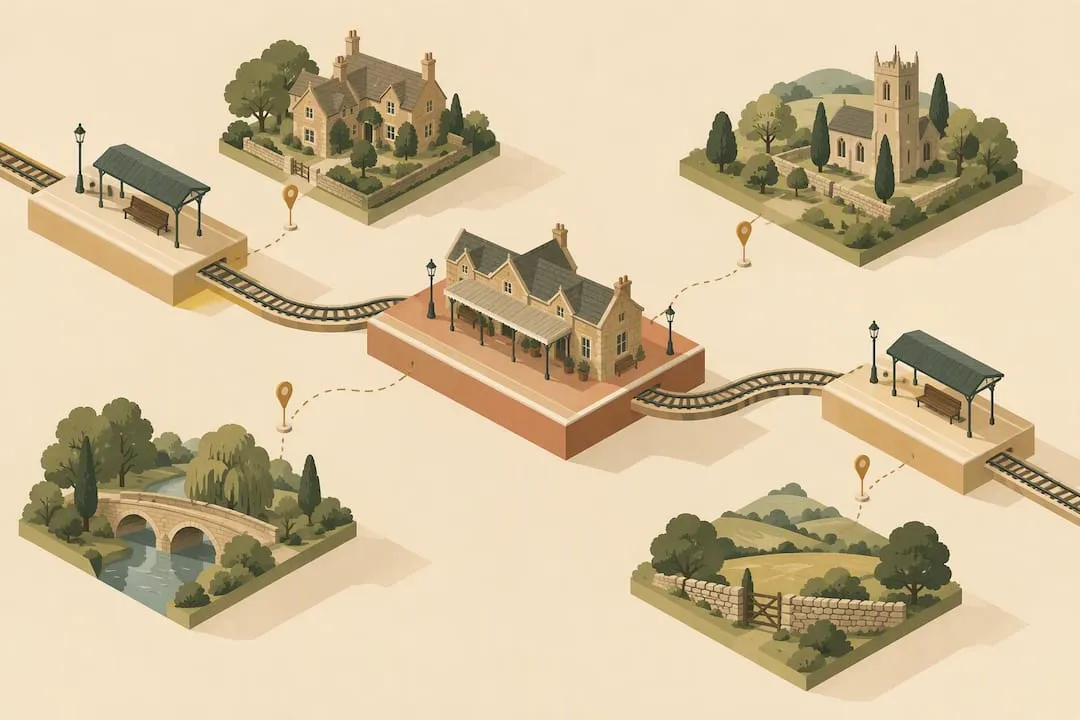
Moreton-in-Marsh is the station most Cotswolds visitors want, with roughly hourly direct trains from London Paddington and an hourly bus onward to Stow-on-the-Wold and Bourton-on-the-Water. But it is not the right answer for everyone: Kingham is closer to Daylesford and Chipping Norton, Kemble is the station for Cirencester, and if step-free access matters, Charlbury and Gloucester beat both.
TL;DR:
- Two Great Western Railway routes serve the region, both direct from Paddington: the Cotswold Line through Charlbury, Kingham and Moreton-in-Marsh, and the line through Kemble, Stroud and Gloucester to Cheltenham Spa.
- Direct trains run to both. There is no need to change at Swindon for Cirencester or Cheltenham — about twenty Paddington services a day run straight through.
- Most villages have no station. The Pulhams 801 is the one genuinely frequent link, running hourly seven days a week between Cheltenham, Bourton-on-the-Water, Stow-on-the-Wold, Moreton-in-Marsh and Chipping Norton.
- Sunday is the weak day for almost everything else: no Kemble–Cirencester bus, no Broadway buses, and no staffed ticket office anywhere on the Cotswold Line.
- For step-free access, Gloucester is the best station on either route, followed by Charlbury and Honeybourne. Kingham is the one to avoid — its second platform is reached only by steps.
Table of Contents
- Which train stations serve the Cotswolds?
- Key stations: what each one actually gives you
- Getting between stations and villages
- Planning your rail trip: tickets and timing
- How the app helps you plan around your station
- Parking at Cotswolds train stations
- Accessibility at Cotswolds stations
- Car hire and bike rental near stations
- Best station for a first car-free visit
- Plan your Cotswolds visit with the app
- Sources
Which train stations serve the Cotswolds?
Two Great Western Railway routes do almost all the work, and both run direct from London Paddington. Knowing which one you want is the single most useful decision you will make.
The Cotswold Line — GWR's own timetable calls it the Cotswolds and Malverns line, timetable T6 — runs Paddington, Reading, Didcot Parkway, Oxford, then Hanborough, Combe, Finstock, Charlbury, Ascott-under-Wychwood, Shipton, Kingham, Moreton-in-Marsh, Honeybourne, Evesham, Pershore and Worcestershire Parkway before Worcester and on towards Hereford. This is the one that threads through the honey-stone north and centre of the region.
Four of those are request stops with a token service rather than an hourly one, and it matters if you are planning around them: Combe, Finstock and Ascott-under-Wychwood each get two trains a day, Mondays to Fridays only, and close entirely at weekends. Shipton has two or three each way on weekdays, about four on Saturdays, and none on Sundays. At a request stop you tell the conductor in good time to get off, and signal clearly to the driver to get on.
The second route runs via Kemble, Stroud, Stonehouse, Gloucester and Cheltenham Spa. GWR calls it the South Cotswolds line (timetable B7); you will also see the historic name Golden Valley Line, after the Frome valley between Chalford and Stroud, though strictly that line runs only from Swindon to just north of Stonehouse, with Gloucester and Cheltenham Spa beyond it. This is the route for Cirencester, Tetbury, Painswick, the Slad Valley and Cheltenham's Regency streets.
Roughly hourly direct trains run from Paddington on both. On the southern route that means about twenty services a day each way on weekdays — every weekday Paddington departure runs through to Cheltenham Spa — seventeen on Saturdays and fifteen on Sundays. Typical direct times from Paddington:
- Charlbury about 1 hour 10 minutes
- Kemble about 1 hour 10 minutes
- Moreton-in-Marsh about 1 hour 25 to 1 hour 35 minutes
- Stroud about 1 hour 25 minutes
- Gloucester about 1 hour 45 minutes
- Cheltenham Spa about 2 hours
If your trip is built around Bourton-on-the-Water, Stow-on-the-Wold or Broadway, take the Cotswold Line. If it is Cirencester, Painswick or Cheltenham, take the southern one.
Key stations: what each one actually gives you
Choosing a station is less about the map pin than about what happens when you step off the platform.
- Moreton-in-Marsh. A proper market town in its own right, and the most practical arrival point for the northern Cotswolds. The Pulhams 801 calls at the station itself and runs hourly, every day, to Bourton-on-the-Water, Stow-on-the-Wold and Chipping Norton. It is also the realistic railhead for Broadway, ten miles away, via Stagecoach routes 1 and 1A on Mondays to Saturdays.
- Charlbury. Quieter and prettier, opening up Wychwood Forest and the eastern villages — and it has the same roughly hourly service as Moreton-in-Marsh, not a thinner one. It is also one of the best stations on the line for step-free access.
- Kingham. Rural and well placed for Daylesford, under three miles away, and Chipping Norton, five. There are no frequent buses, so book a taxi rather than hoping one appears. For Chipping Norton specifically, Moreton-in-Marsh plus the hourly 801 is often the easier car-free route.
- Kemble. The station for Cirencester, four and a half miles away by road, and for Tetbury. There is a taxi rank, and the Stagecoach 882 bus, but that runs only about seven times a day, Mondays to Saturdays, with no evening and no Sunday service at all.
- Cheltenham Spa, Gloucester and Stroud. Larger stations with denser onward bus networks into the western and southern Cotswolds. Gloucester and Cheltenham Spa are also the only two stations on either route staffed into the evening and on Sundays.
- Honeybourne. Often described as the station for Broadway. It is not. Broadway is seven miles away, there is no bus between them, and National Rail states the station has no taxi rank or cab office, so a cab must be booked in advance. It is unstaffed, with eleven parking spaces and one bus route, the 553 to Evesham, Mondays to Saturdays only. For Broadway, use Moreton-in-Marsh or Evesham — which is what Broadway's own visitor site recommends.
- Worcestershire Parkway. Newer, north of the region, and worth knowing about: it is fully step-free and staffed from 5am to 8pm every day including Sundays, which makes it the most reliably assisted station on the route.
Getting between stations and villages
Stepping off the train is only half the journey. Most Cotswold villages have no station, so buses and taxis fill the gap — and the quality of that link varies enormously by day of the week.
- The Pulhams 801 is the backbone. It runs Cheltenham (Royal Well), Charlton Kings, Andoversford, Notgrove, Bourton-on-the-Water, Stow-on-the-Wold, Donnington, Moreton-in-Marsh (calling at the railway station) and Chipping Norton — hourly, seven days a week, all year. Later evening journeys were added from May 2026. The last bus back to Moreton-in-Marsh station leaves Bourton-on-the-Water at 9.20pm on weekdays, 8.20pm on Saturdays and 5.20pm on Sundays, and the last departures from the station run only as far as Bourton.
- From Kemble, the Stagecoach 882 reaches Cirencester in about twenty minutes and continues to Tetbury, but only about seven times a day, Mondays to Saturdays, with nothing in the evenings or on Sundays.
- Taxis are worth pre-booking at Kingham, Charlbury and especially Honeybourne, which has no rank at all.
- Sunday is the weak day. The 882 to Cirencester, the 553 from Honeybourne, and the Stagecoach 1 and 1A to Broadway all stop for the weekend. The 801 is the exception, and that is why it shapes so many car-free itineraries here.
Pro Tip: Check bus timetables the night before, not on the morning of travel, and check the return leg as carefully as the outward one. A route that looks generous at 10am can have finished for the day by the time you want to come back.
Planning your rail trip: tickets and timing
Advance fares booked through GWR well ahead of travel can cut the cost substantially, particularly from Paddington. Two combined rail-and-bus options exist, and the difference between them matters:
- The GWR Rail Link combined ticket, introduced in June 2026, covers the train to Moreton-in-Marsh plus the Pulhams 801 onward to Bourton-on-the-Water, Stow-on-the-Wold or Chipping Norton on a single e-ticket you can buy online. The bus leg takes about half an hour. For most visitors heading to the northern villages, this is the straightforward choice.
- The Cotswolds Discoverer one-day pass still exists — around £15 for an adult at the time of writing — but read the small print before relying on it. Its bus validity is Stagecoach services only, which means it does not cover the Pulhams 801. It is not valid on trains before 8.50am on weekdays, it does not cover the journey from London, and you cannot buy it online: it comes from a staffed ticket office or from a participating bus driver.
That last point is a real trap here. Ticket offices on the Cotswold Line open early and close around midday, and none of them open on Sundays. Honeybourne, Hanborough and Pershore are unstaffed at all times. A visitor arriving at Moreton-in-Marsh on a Sunday afternoon cannot buy a Discoverer pass there at all.
A few things worth doing before you go:
- Book Advance fares as early as your plans allow
- Check whether the GWR Rail Link ticket covers your onward village
- Check accessibility on National Rail's own station pages or GWR's, rather than on a ticket-selling site
- Pack light — cobbled high streets and country lanes are not luggage friendly
- Build a buffer into the return journey, especially on rural bus connections
How the app helps you plan around your station
Once you know your arrival station, the useful question is what sits within reach of it. The Cotswolds map lets you filter by category — pubs, tearooms, walks, viewpoints, gardens — and search for a village by name, and each place page carries its address, opening hours where we hold them, and visitor ratings including accessibility and dog-friendly scores where people have left them. Save the stops you like into an itinerary, and download the area before you travel: signal on these lines is patchy, and an offline copy of the map and listings keeps working when your phone does not.
Parking at Cotswolds train stations
If you are combining a short drive with the train, every station here has a car park and none of them is free. All are run by APCOA, and daily charges at the time of writing run from about £3.50 off-peak to about £6.80 on a weekday — weekends and afternoons are consistently cheaper than weekday mornings.
One common assumption is worth correcting: Moreton-in-Marsh does not have the biggest car park on the line. GWR lists about 128 spaces there, against roughly 140 at Kingham, 158 at Charlbury and 220 at Kemble. It is the busiest, which is a different thing, so arriving before mid-morning at a weekend still makes sense.
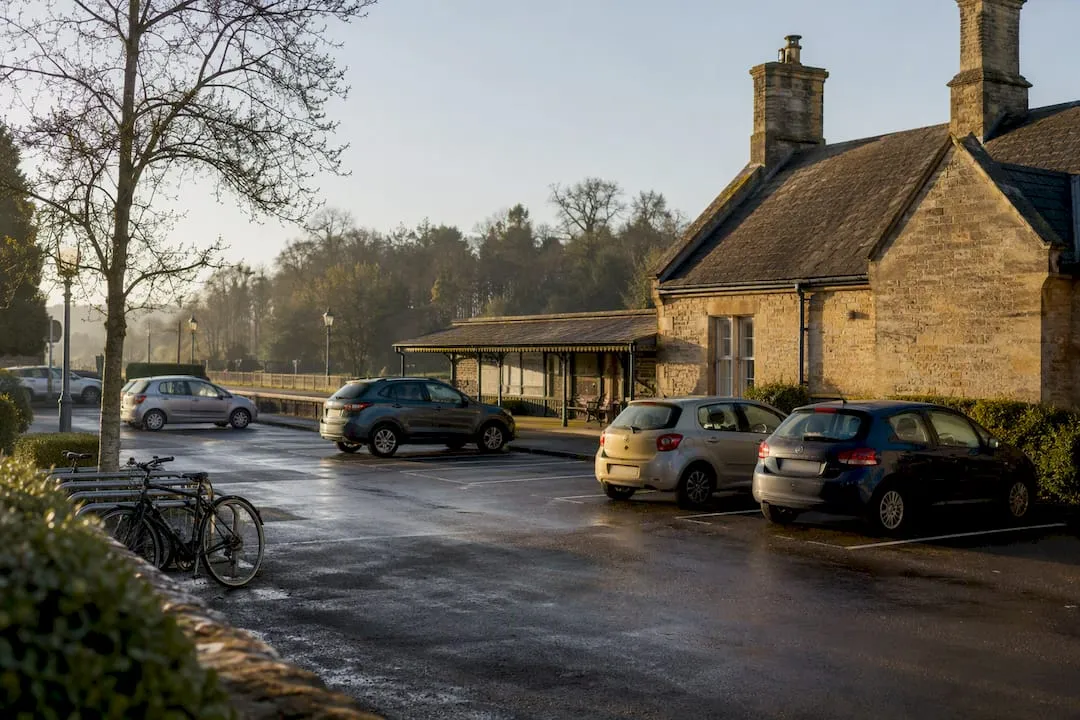
Two practical warnings. Kingham is cashless — payment is by the APCOA app or a scan-to-pay code, and the machines take neither cash nor card. And Moreton-in-Marsh and Kingham have no designated accessible bays at all, where Charlbury has five and Kemble ten. Blue Badge holders park free at Kingham, but only if the badge is registered in advance. Check the specific station page before travelling rather than assuming a flat regional rate.
Accessibility at Cotswolds stations
Step-free access here does not follow station size, and the pattern is close to the opposite of what most visitors assume. These are GWR's own classifications:
- Best: Gloucester. Step-free to every platform, with lifts, an accessible toilet and a Changing Places facility, staffed from 5am to midnight on weekdays. Worcestershire Parkway, further north, is similarly step-free and staffed every day.
- Also fully step-free: Charlbury and Honeybourne. Both reach both platforms step-free by ramped bridges. Charlbury is one of only two two-platform stations on the Cotswold Line to manage this. Honeybourne, though, is entirely unstaffed.
- Step-free but by ramp, with no lifts: Moreton-in-Marsh, Cheltenham Spa and Stroud. GWR describes Cheltenham Spa's ramps as steep, which matters if you are pushing yourself. Moreton-in-Marsh is step-free to platform 2 only.
- Not step-free to both platforms: Kingham. Its second platform is reached only by a stepped bridge. If you are travelling in that direction and cannot manage steps, this is the station to avoid.
Staffing is the other half of the picture, and it is thinner than the size of a station suggests. Every ticket office on the Cotswold Line — Charlbury, Kingham, Moreton-in-Marsh — opens early and closes around the middle of the day, and none of them opens on Sundays. Stroud closes at 2pm and is also shut on Sundays. Only Gloucester and Cheltenham Spa are staffed into the evening and at weekends.
You can book assistance through Passenger Assist up to two hours before your journey, at any time of day, rather than the day before, and turn-up-and-go is formally supported. But turn-up-and-go depends on somebody being there — and on this line, after early afternoon or on a Sunday, nobody is. Booking ahead is genuinely the safer course here even though the national rule is more relaxed.
Car hire and bike rental near stations
A car-free trip works well from a single gateway station, but some visitors want wheels for the last stretch.
Cheltenham Spa and Gloucester, as larger towns, have the widest choice of car hire and the most competitive prices. Moreton-in-Marsh has no hire desk at the station, though firms in the town centre are a short walk away and will often deliver to the forecourt if you call ahead. Kemble and Kingham are quieter still, so book in advance rather than arriving and hoping.
Bike hire is patchier. Ringing ahead beats turning up, since rural operators tend to run on a handful of machines rather than a fleet. Around Stroud, where the valleys are steep, an electric bike is worth the premium over a standard one.
Best station for a first car-free visit
Moreton-in-Marsh remains the clearest choice for a first car-free visit, for one reason above all others: the 801 runs hourly, seven days a week, and reaches the villages most people have come to see. Nothing else in the region offers that. The town itself is pleasant enough to fill an hour if a connection is tight.
If step-free access is the deciding factor rather than onward buses, Charlbury or Gloucester are the better arrival points.
Plan your Cotswolds visit with the app
Once the station is settled, the harder question is what to do once you arrive, and that is where rail-only itineraries usually come unstuck. The Cotswolds App maps thousands of places across the region — villages, pubs, tearooms, walks, viewpoints — so you can build a rough plan before you leave home and carry it offline on the train.
It is a planning tool, not a substitute for live times. Always confirm trains with GWR and buses with the operator close to the day. Install the app and start putting a station-led day together.
Sources
Checked against operator and National Rail sources in September 2026. Timetables, fares and staffing change — confirm before you travel.
- Trains to the Cotswolds | Great Western Railway
- Timetables T6 and B7 | Great Western Railway
- Station accessibility and facilities | National Rail
- Passenger Assist | National Rail
- Service 801 timetable | Pulhams Coaches
- Combined train and bus tickets | Great Western Railway