

Romantic Cotswolds for Couples: Where to Stay, Quiet Villages and a Two-Day Loop
11 October 2026Last checked 11 October 2026
A romantic Cotswolds trip usually comes down to two choices: where you sleep, and the one or two moments you build the weekend around, such as a sunset on the escarpment, an early walk before the villages wake up, or a long dinner at the inn you are staying in. This guide covers where to stay, what to do together, a two-day village loop by car, when the busiest villages are quietest, and how to plan it without rushing.
TL;DR:
- Book early for spring and summer weekends, and ask for the room you want (a view, a roll-top bath, a garden) rather than assuming it, because rooms in old buildings vary.
- Split the classic villages over two days rather than one, base yourselves somewhere central such as Stow-on-the-Wold, and arrive at Bibury and Bourton early or late in busy months.
- Without a car, Moreton-in-Marsh has the station and the 801 bus links it with Stow and Bourton; pick a base you can reach and explore from there.
- Broadway Tower is the classic sunset spot. The tower and its grounds are ticketed with set opening hours, so check before you plan a moment around it.
Table of Contents
- Where to stay: country-house hotels, inns with rooms and cottages
- Things to do together
- A two-day village loop by car
- When the villages are quietest
- Choosing a base and getting around
- Planning the trip in The Cotswolds App
- Time by the water
- Events and festivals
- Tips for surprises or proposals in the Cotswolds
- Sources
Where to stay: country-house hotels, inns with rooms and cottages
Your choice of stay sets the tone for the whole trip, and the Cotswolds offers three broad kinds. Country-house hotels, some with spas, make a weekend feel like an occasion, with dinner on site so nobody has to drive. Old coaching inns and pubs with rooms are usually gentler on the budget and give you a fire and a bar downstairs. Self-catering cottages suit couples who want privacy and their own pace.
- Country-house hotels: found across the region, including around Broadway and Chipping Campden in the north.
- Inns with rooms: towns such as Stow-on-the-Wold and Burford grew up on coaching routes, and several old inns there still let rooms above the bar.
- Cottages: holiday cottages in and around the smaller villages, such as Bibury and the Slaughters, give you the quiet once the day visitors leave.
When you book, ask for a room with a view, a roll-top bath or a private garden rather than assuming one comes as standard, since rooms in historic buildings rarely match each other. Spring and summer weekends fill early, so book well ahead if you have a fixed date.
Pro Tip: Mention the occasion when you book. Smaller inns and hotels can often arrange something small, such as a particular table or a bottle waiting in the room, if they know in advance.
Things to do together
Romance here rarely needs a big budget. Some of the best moments cost nothing beyond getting up early or staying out late.
- Walk a short stretch of a long-distance path such as the Cotswold Way or the Windrush Way early in the morning or in the last hour of daylight, when the light on the stone is softest and the paths are quietest. Our Cotswolds hikes guide has routes and distances.
- Visit a garden. Hidcote, the National Trust garden near Chipping Campden created by Lawrence Johnston, is laid out as a series of enclosed garden rooms that reward a slow wander. Painswick Rococo Garden, just outside Painswick, opens Wednesday to Sunday and welcomes dogs on short leads. Check opening times on each garden's own site before you go.
- Take a hot-air balloon flight. Several operators fly over the Cotswolds. Flights depend entirely on the weather and are often rescheduled, so treat a booked date as provisional and keep the rest of the day flexible.
- Book a spa afternoon or an afternoon tea to slow the pace after a morning of walking or driving.
- Walk through the lavender in summer. Cotswold Lavender at Snowshill opens its display field for a few weeks each summer, usually from mid-June to early August, and has picnic benches among the rows. Our lavender guide covers timing and the farm's rules.
Most of these fit into half a day, leaving the rest free for a long lunch or doing very little, which is often the best plan of all.
A two-day village loop by car
The best-known villages are spread further apart than they look, so they are more relaxing over two days than crammed into one. Distances below are straight-line from our map, so road distances are longer, and summer traffic adds time.
- Day one, the south and centre: start at Burford, then drive to Bibury (about 9 miles as the crow flies) for Arlington Row, the row of cottages that began as a monastic wool store around 1380. From Bibury, head north to Bourton-on-the-Water (about 9 miles), then walk the mile beside the River Eye from Lower Slaughter to Upper Slaughter before finishing at Stow-on-the-Wold, a few miles further on.
- Day two, the north: from Stow, drive to Chipping Campden (about 9 miles), on to Broadway (under 4 miles), and save Broadway Tower, about a mile and a half above the village, for the end of the day.
- Drive slowly and park early. Many lanes are narrow, some with passing places only, and village car parks fill by mid-morning in summer. A smaller car makes both easier.
Our three-day itinerary covers the same villages at a slower pace, with buses for anyone not driving.
When the villages are quietest
Knowing when to arrive matters as much as knowing where to go. Bibury and Bourton-on-the-Water are quietest before 10am and again in the late afternoon, once the coach parties have moved on. The Slaughters are small and stay calmer for most of the day. Castle Combe, in the far south of the region, is another much-photographed village that rewards an early or late visit, but it is a long way from the loop above, so treat it as a separate trip.
- Late winter brings snowdrops, usually in February, and quiet lanes.
- Spring adds blossom and fresh green hedgerows before the main season starts.
- Summer brings the lavender at Snowshill, and the busiest weeks in the villages.
- Autumn colours the beech woods, with fewer visitors than in July and August.
- Winter has fires in the inns and empty lanes, though some gardens and attractions close or shorten their hours, so check before you travel.
Pairing a busy stop such as Bibury with a quieter one such as the Slaughters keeps the postcard views without spending the whole day in crowds.
Choosing a base and getting around
Where you stay shapes how relaxed the trip feels, and the right choice depends mostly on whether you are driving.
- By car, Stow-on-the-Wold sits near the middle of the loop: Bourton and the Slaughters are a few miles away, and Bibury, Chipping Campden and Broadway are all within about 13 miles in a straight line.
- By train, Moreton-in-Marsh is on the line from London Paddington, and Cheltenham Spa has direct trains too. Our guide to Cotswolds stations covers which is which, including step-free access.
- Without a car, pick one base you can reach by train or bus and explore nearby villages from there rather than trying to cover the whole loop. The Pulhams 801 links Moreton-in-Marsh with Stow-on-the-Wold and Bourton-on-the-Water. Our car-free guide has the details and the last buses back.
- Leave slack between stops. Narrow lanes and full car parks make a packed day feel rushed.
Planning the trip in The Cotswolds App
The Cotswolds App is a free guide to thousands of places across the region. Here is what it can and cannot do for a weekend like this.
- Browse by category. The directory lets you browse places by category, such as places to stay, pubs or gardens, search by name, and narrow the list to places within a set distance of you. There are no filters for features such as hot tubs or four-poster beds, so check those with the hotel.
- See it on a map. The map shows places across the region, so you can see what is near your base.
- Read the area guides. Town guides such as things to do around Stow-on-the-Wold and around Broadway list what is nearby.
- Check ratings on each place page. Visitors can leave sheep, accessibility and dog-friendly ratings, but most places have few or no reviews yet.
- Build an itinerary. With a free account you can save places to visit and build an itinerary: add your stops, put them in order, split them across days and see the driving time between each one.
A simple way to use it: choose your base, look at what is around it on the map, then put the villages you want into an itinerary and see how long each drive will take.
Time by the water
The rivers here suit slow, quiet time together. Bourton-on-the-Water, often called the Venice of the Cotswolds, has low stone bridges over the River Windrush and benches along the water. Just upstream, the Slaughters sit on the smaller River Eye, which runs past the old watermill at Lower Slaughter and joins the River Dikler, a tributary of the Windrush.
Punting is an Oxford and Cambridge tradition rather than a Cotswolds one, so the romance here is in walking beside the water rather than being on it. A riverside walk or a picnic at Bourton or the Slaughters in the early evening, once the day visitors have gone, is the easiest way to enjoy it.
Events and festivals
Open-garden days, village fairs, food festivals and Christmas markets run across the region through the year, many organised by parishes, charities and small volunteer groups. Dates change every year, so check current listings close to your travel dates rather than planning a trip around an event you assume will happen.
Our events calendar lists charity and community events across the Cotswolds, with dates, places and how to get there.
Tips for surprises or proposals in the Cotswolds
A proposal here works best when it leans on the landscape. Broadway Tower stands on the escarpment above Broadway with views far out across the Vale of Evesham, which is why it is a favourite for exactly this. Its story is about a beacon rather than a love token: it was designed by James Wyatt and built in 1798 to 1799 for the 6th Earl of Coventry, and the story usually told is that Lady Coventry wanted to know whether a beacon on the hill could be seen from their home near Worcester, about 22 miles away.
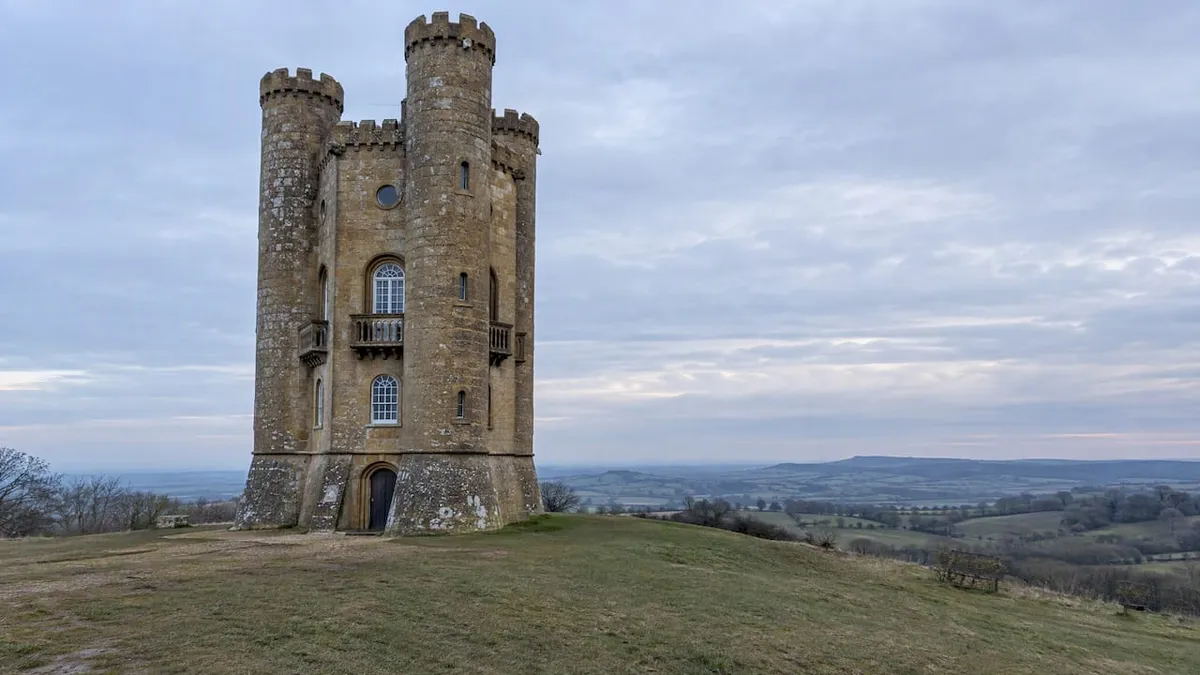
The tower and its grounds are ticketed and have set opening hours, and the Cotswold Way passes through the grounds free of charge. Check the tower's own website before planning a sunset there. Dover's Hill, above Chipping Campden, is a free alternative with a wide view.
Timing matters more than props. Early morning or the hour before sunset gives you the best chance of a viewpoint to yourselves. If you are involving a hotel or inn, a quiet word in advance can secure a particular table or room.
Keep a backup plan for the weather, since an exposed hilltop is far less appealing in driving rain. A table booked at a pub with a fire nearby means the moment still works if the sky does not.
Sources
- Broadway Tower official website
- Hidcote, National Trust
- Things to do in Bibury, National Trust
- Painswick Rococo Garden
- Cotswold Lavender