

For first-time visitors and families, the essentials are Bourton-on-the-Water for gentle river walks, a short stretch of the Cotswold Way, Blenheim Palace for grand history, and a half day at Cotswold Wildlife Park or Cotswold Farm Park for the children. Walkers and couples should add Bibury and Broadway to the list. A single day covers the honeypot villages comfortably; give yourself three to four days if gardens, castles and quieter trails are on your wish list too.
TL;DR:
- Visiting Bibury early in the morning before 10 am helps avoid crowds and captures the best light on Arlington Row.
- The Cotswold Way covers 102 miles suitable for short sections, with two to three-hour walks offering sweeping valley views.
- Blenheim Palace requires full-day visits, especially in summer, with advance ticket booking recommended for a seamless experience.
- Quieter nature reserves around river valleys and woodland trails offer free, less crowded walks with scenic honey-stone scenery and open skies.
- Planning a three to four-day trip enables exploration of gardens, castles, and peaceful trails alongside the main village attractions.
Table of Contents
- Top 10 things to do in the Cotswolds
- Activities grouped by type: walks, gardens, houses and more
- How to plan your Cotswolds visit
- How The Cotswolds App helps you plan these visits
- Family walking trails and nature reserves worth seeking out
- Themed day-trip routes: literary, culinary and village-hopping tours
- Best viewpoints and photo spots
- Festivals and seasonal events worth building a trip around
- Balancing the honeypots with the quiet stretches
- Plan your route with The Cotswolds App
- Sources
Top 10 things to do in the Cotswolds
Some names on this list you will already know. A few, especially the arboreta and the farm parks, tend to get overlooked by first-time visitors who only have a weekend, which is a shame given what they offer.
- Blenheim Palace — the region’s grandest stately home, a UNESCO World Heritage Site with parkland landscaped by Capability Brown. Best for history lovers and families; allow a full day, and book palace tickets ahead in summer.
- Cotswold Way — the 102-mile National Trail running from Chipping Campden to Bath. Best for walkers of any fitness level, since short two to three-hour sections suit a half day.
- Bourton-on-the-Water — known as the “Venice of the Cotswolds” for its low stone bridges over the River Windrush. Best for families with young children; a half day is plenty, longer with a stop for a model village or motoring museum.
- Bibury — home to Arlington Row, one of the most photographed streets in England. Best for couples and photographers; an hour or two is enough, though it gets busy by mid-morning.
- Broadway — a wide, tree-lined high street backed by Broadway Tower on the hill above. Best for a relaxed browse of shops and tearooms; half a day, with an option to walk up to the tower.
- Cotswold Wildlife Park & Gardens — rhinos, giraffes, big cats and a walled garden in parkland south of Burford. Best for families; a full day if you include the play areas and train ride.
- Batsford Arboretum — one of the largest private tree collections in the country, spectacular in autumn colour and spring blossom. Best for garden lovers and quiet walkers; two to three hours.
- Hidcote Manor Garden — an Arts and Crafts garden of “outdoor rooms” that shaped English garden design. Best for garden enthusiasts; half a day, ideally paired with nearby Kiftsgate Court.
- Sudeley Castle — the burial place of Katherine Parr, with award-winning gardens and exhibitions. Best for history fans and families; half a day.
- Cotswold Farm Park — rare-breed animals and hands-on experiences, at their best during spring lambing season. Best for younger children; half a day, timed around feeding sessions.
Activities grouped by type: walks, gardens, houses and more
Splitting the region by interest rather than by village makes planning far simpler, especially if your group has mixed priorities.
Walks and trails. The Cotswold Way rewards even a short outing. A popular stretch runs from Chipping Campden to Broadway (5 to 6 miles, easy to moderate, taking in Broadway Tower), while Birdlip to Painswick offers sweeping views over the Severn Vale for a similar effort. Neither section demands specialist gear, just decent boots and a packed lunch.
Gardens and arboreta. Hidcote and neighbouring Kiftsgate Court sit almost side by side, so a single visit covers both. Batsford Arboretum is spectacular in spring blossom and autumn colour. Westonbirt, further south, is worth the detour if you are travelling with a longer window; its autumn colour draws visitors from well outside the region.
Historic houses and castles. Blenheim Palace remains the standout for scale and pedigree, its parkland alone justifying a morning walk before you even reach the state rooms. Sudeley Castle pairs Tudor history with genuinely impressive planting, and Snowshill Manor, with its eccentric collections, suits visitors who prefer something less polished than the grand estates.
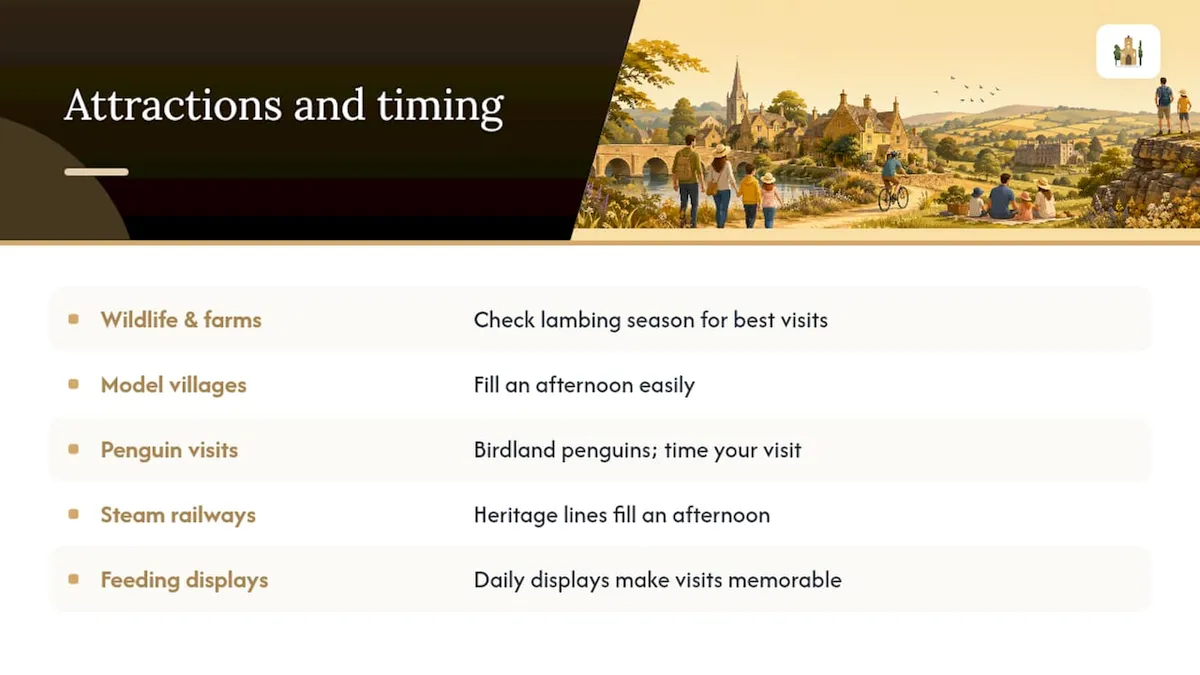
Family attractions. Beyond the wildlife and farm parks, model villages, Birdland’s penguin colony, and the region’s heritage steam railways fill an afternoon easily. Timing matters here: lambing season and daily feeding displays turn a good visit into a memorable one.
Food, pubs and markets. Moreton-in-Marsh hosts a long-running Tuesday market, and farm shops such as Daylesford sell produce grown within sight of the till. Combining a short walk with a pub lunch suits families and older visitors particularly well, since nobody has to walk far to eat.
Lakes and outdoor adventure. Cotswold Lakes offers paddleboarding, kayaking and other watersports, a welcome contrast to village strolling on a warm afternoon.
Pro Tip: Visit Bibury before 10am. Arlington Row draws coach parties by mid-morning, and the light on the Cotswold stone is better early anyway.
How to plan your Cotswolds visit
A single day suits the classic villages; three to four days lets you add gardens, castles and quieter trails without rushing.
- Choose your base. Moreton-in-Marsh works well for train travellers; Broadway or Bibury suit those wanting a scenic overnight stay, and Cirencester offers more shops and services if you need them.
- Sort your transport. Trains from London Paddington reach Moreton-in-Marsh in around 90 minutes. Driving gives more flexibility, though village car parks fill fast in summer, and bus links between villages are limited. Guided full-day tours covering Bibury, Bourton-on-the-Water and Stow-on-the-Wold are a sensible option if nobody in your group drives; prices vary by operator and season, so check directly with whoever you book.
- Pick your season. July and August are busiest, particularly around Bourton-on-the-Water and Bibury. May, June and September offer quieter villages with equally good weather.
- Check accessibility. Bourton-on-the-Water’s riverside paths are pushchair-friendly, and Blenheim Palace and Sudeley Castle both have accessible routes and facilities, though some village high streets have uneven pavements.
How The Cotswolds App helps you plan these visits
The Cotswolds App maps thousands of places across the region, filterable by category, with visitor ratings on every place. Build a one-day loop around Bourton-on-the-Water, then filter nearby for a pub lunch, using the interactive map to see everything within reach.
Family walking trails and nature reserves worth seeking out
Not every good walk sits inside a paid attraction. Several nature reserves and informal trails across the Cotswolds offer the same honey-stone scenery and open skies without an entry fee, and they tend to stay far quieter than the headline villages.
Look for shorter circular routes around river valleys near Bibury and the Coln Valley, where flat, well-marked paths suit pushchairs and younger legs. Woodland trails near Cranham and the Painswick Beacon area combine gentle gradients with wide views over the valley, ideal for a mid-morning outing before lunch. Many of these paths link small hamlets rather than the famous villages, so you get riverside footpaths that feel worlds apart from the coach parties a few miles away.
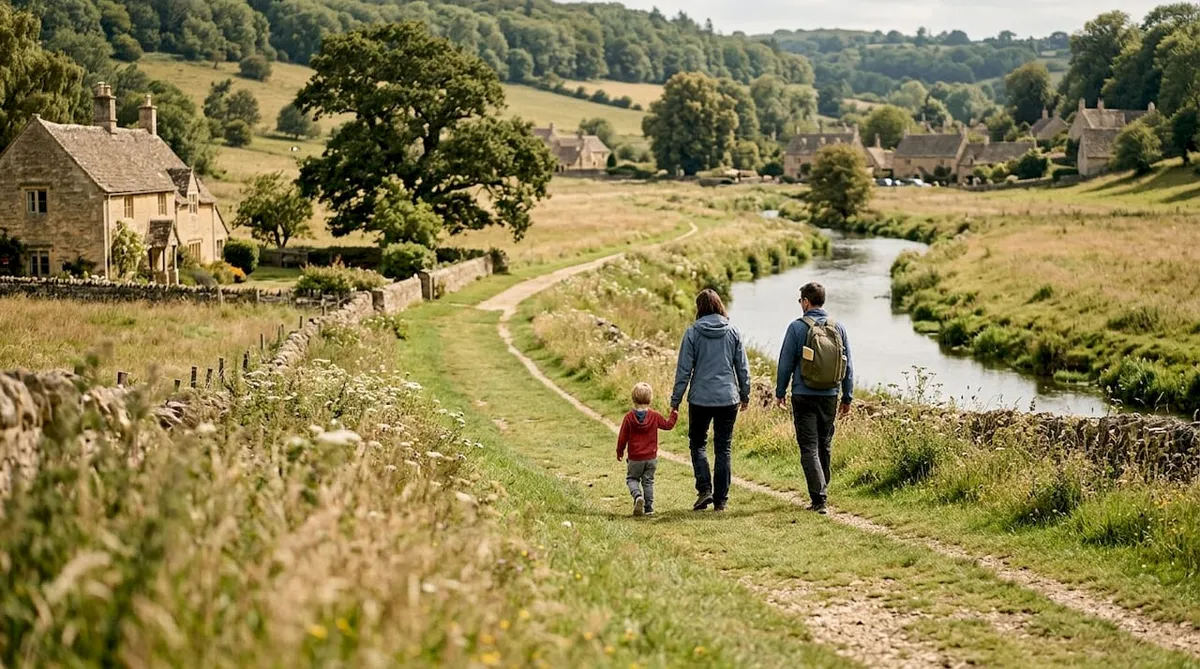
Wildflower meadows appear across the region from late spring, and several reserves manage their grasslands specifically to support orchids and butterflies, making June and July rewarding months for a slow amble rather than a brisk walk. None of these require booking or tickets, which makes them a useful counterbalance to a day built around timed entry slots at the bigger attractions.
If you are travelling with a dog, these informal trails are usually a better bet than the formal gardens and parks, several of which restrict access to guide dogs only. Checking a filtered map before you set off saves a wasted walk back to the car.
Themed day-trip routes: literary, culinary and village-hopping tours
A themed route gives a day trip shape, rather than a list of names ticked off in sequence.
A literary trail works well through the North Cotswolds, tracing the countryside that inspired writers and artists drawn to the area’s light and landscape, with stops in Chipping Campden and Broadway for their unbroken high streets and historic coaching inns.
A culinary route might start at Moreton-in-Marsh market, move on to a farm shop such as Daylesford for lunch, and finish with a pub dinner in a village like Stow-on-the-Wold. This suits food-focused travellers who want to taste the region rather than simply photograph it.
A village-hopping day, the most popular structure for first-timers, typically runs Bibury, Bourton-on-the-Water and Stow-on-the-Wold in one loop, echoing the structure of most guided day tours. Add Castle Combe if you are travelling from the southern Cotswolds, since it sits well outside the northern cluster and rewards a slight detour.
Whichever route you choose, build in slack. Traffic through narrow village lanes in peak season adds real time to even short hops between stops, and a day that looks tight on a map often runs 30 to 45 minutes over.
Best viewpoints and photo spots
Broadway Tower, standing on one of the highest points in the Cotswolds, gives a clear view across several counties on a good day and is arguably the single best panoramic spot in the region. Dover’s Hill, just above Chipping Campden, offers a similarly wide outlook without the entry fee, and it catches superb light at sunset.
Arlington Row in Bibury is the most photographed single scene in the Cotswolds, though its popularity means an early visit pays off if you want the street without a crowd in every frame. Bourton-on-the-Water’s low bridges over the Windrush make for reliably pretty shots, particularly with a bit of morning mist rising off the water in autumn.
For something less obvious, the wildflower meadows and drystone walls around Snowshill offer a quieter, more textured version of the classic Cotswolds image, honey-stone cottages against rolling green hills, without another photographer in sight.
Festivals and seasonal events worth building a trip around
Some of the most memorable Cotswolds experiences are entirely free and happen only once a year. Cooper’s Hill Cheese Rolling, held at Brockworth on the late-May bank holiday, sends competitors chasing a wheel of cheese down a near-vertical slope. One thing to know before building a trip around it: the official event was cancelled in 2010 on safety grounds and it has run unofficially ever since, with no organiser, no ticketing and no safety plan. Thousands still turn up, but go as a spectator and treat the hill with respect.

The Cotswold Olimpick Games, held on Dover’s Hill above Chipping Campden on the Friday after the late-May bank holiday, mix shin-kicking with more conventional athletics. First staged around 1612, they stopped at the Civil War, returned after the Restoration, ended again in 1852 when Dover’s Hill was enclosed, and were revived for the 1951 Festival of Britain — running annually only since 1966. Genuinely old, then, but not unbroken. The Big Feastival, held each summer near Kingham, combines live music with food stalls from well-known chefs, drawing a younger crowd than the village fetes elsewhere in the calendar.
The Tetbury Woolsack Races — the last survivor of their kind, run in the town on the late-May bank holiday Monday and revived in 2024 after a four-year break — and the Cotswold Beer Festival at Postlip Hall near Winchcombe fill out the summer months. None of these events need advance planning beyond checking the date, but accommodation nearby books up fast, so sort a base early if a festival is the reason for your trip.
Balancing the honeypots with the quiet stretches
Bourton draws the crowds; Bibury draws the cameras. The trick is to catch Bibury before 9am, then spend the afternoon somewhere nobody photographs. The best Cotswolds trips balance both.
Plan your route with The Cotswolds App
Building a Cotswolds itinerary from scratch means juggling opening times, parking, and which village actually suits your group, which is exactly where a filtered map beats a stack of open browser tabs. The Cotswolds App puts thousands of places on one interactive map, filterable by category, so you can build a day around Bourton-on-the-Water or Bibury and see every nearby pub, walk and attraction without switching apps.
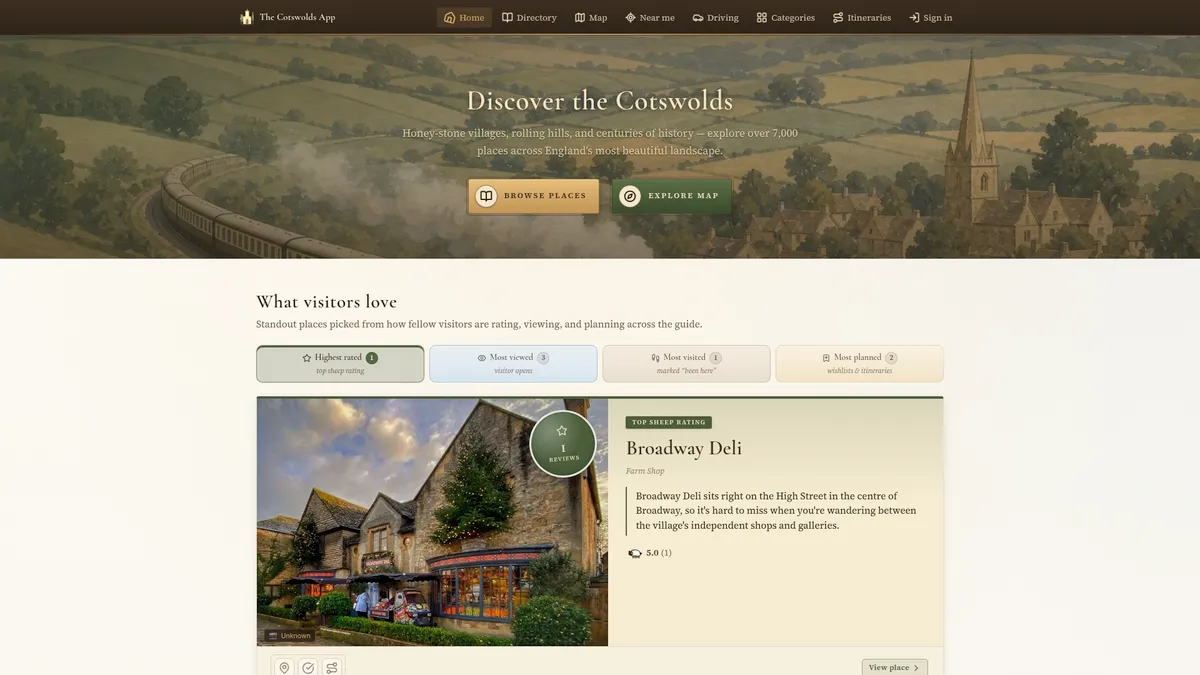
If you are still deciding where to base yourself, the Cotswolds region guide breaks down the main areas and how they connect. Once you know roughly where you are heading, install the app and start filtering places near your route before you set off.
Sources
- Cotswold Way National Trail — GOV.UK
- Animals and gardens — Cotswold Wildlife Park
- Best things to do in the Cotswolds: 11 wholesome ideas | CN Traveller
- Cotswolds | VisitBritain