

Bath to the Cotswolds: A Day Trip by Car, Train, Bus or Tour
11 October 2026Last checked 11 October 2026
From Bath, the southern Cotswolds are close. Castle Combe and Lacock are each around half an hour away by car, and Bradford-on-Avon, on the southern edge of the region, is a short direct train ride from Bath Spa. The best-known villages further north, such as Bibury, take over an hour to reach, and Broadway nearer two. So the first decision is how far north to go, and the second is whether anyone wants to drive.
TL;DR:
- By car, Castle Combe and Lacock are about 30 minutes from Bath on a clear run, and Bibury about an hour or a little more. Village parking is limited, so arrive early.
- Without a car, Bradford-on-Avon is the easy option: direct trains from Bath Spa take about 12 to 15 minutes and run every day.
- Castle Combe and Lacock need a train to Chippenham and then a bus. Castle Combe's bus runs only a few times a day, Monday to Saturday.
- Tours from Bath remove the driving. Check the pickup point, group size, what entry fees are included and the cancellation terms before booking.
- Two or three stops make a better day than five.
Table of Contents
- Transport options from Bath: driving, car hire, train and buses
- Three sample itineraries for a day out
- Guided tours from Bath: shared, private and combined Stonehenge trips
- Planning checklist: timing, tickets, parking and costs
- Where to eat: dining and picnic spots along the way
- Travelling with children or pets
- Weather and what to pack
- History and character in each village
- A realistic day beats trying to see everything
- Plan your day with The Cotswolds App
- Sources
Transport options from Bath: driving, car hire, train and buses
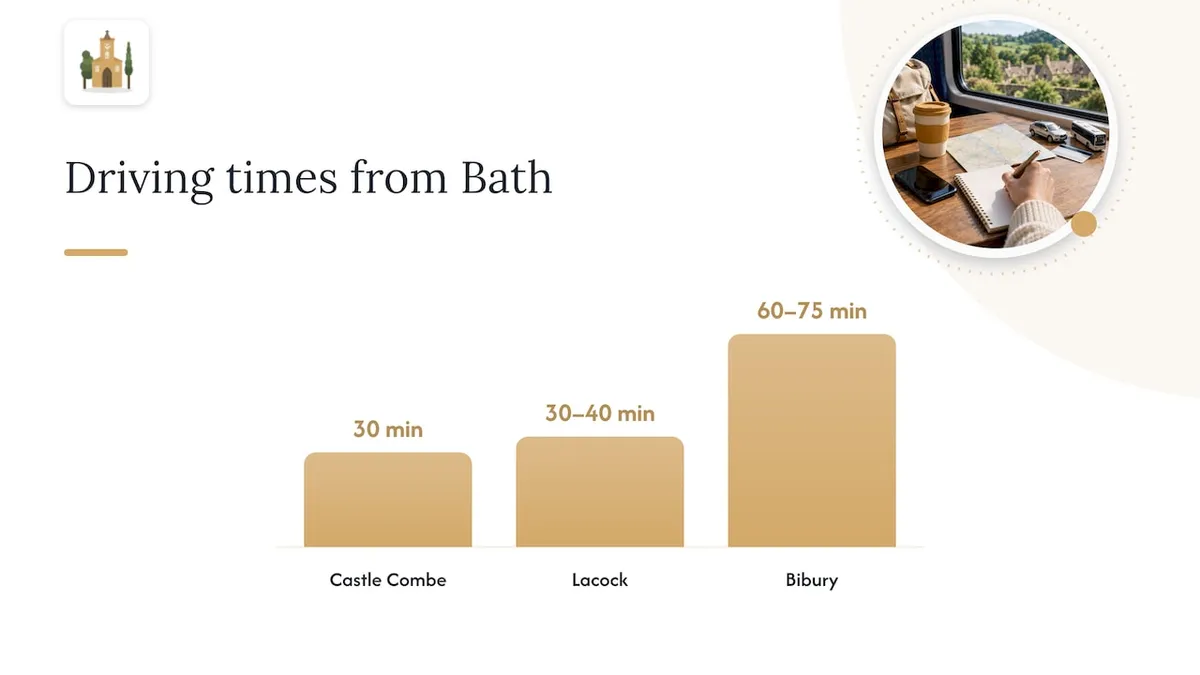
By car. Driving gives you the most freedom, and the nearest villages are closer than many visitors expect. The times below are estimates for a clear run from central Bath, not timetable figures, so check a route planner on the day and add time on summer weekends.
- Castle Combe: about 15 miles, around 30 minutes.
- Lacock: about 13 miles, around 30 to 40 minutes.
- Bibury: about 42 miles, around an hour to an hour and a quarter.
- Broadway: over 70 miles, around an hour and a half to two hours, which makes it a long day from Bath.
The catch is parking. These villages were not built for day-trippers' cars, and spaces go early on fine weekends. If you don't have a car of your own, hiring one for the day from Bath is straightforward; allow for fuel and any extra-driver charge.
By train. Two short direct Great Western Railway journeys from Bath Spa are useful:
- Bradford-on-Avon: about 12 to 15 minutes, with trains roughly every half hour on weekdays and a service on Sundays too. The town sits right on the edge of the Cotswolds National Landscape, and the station is step-free to all platforms, though National Rail notes some long or steep ramps.
- Chippenham: about 11 minutes non-stop, several trains an hour on weekdays and fewer on Sundays. Chippenham is the rail and bus hub for Castle Combe and Lacock.
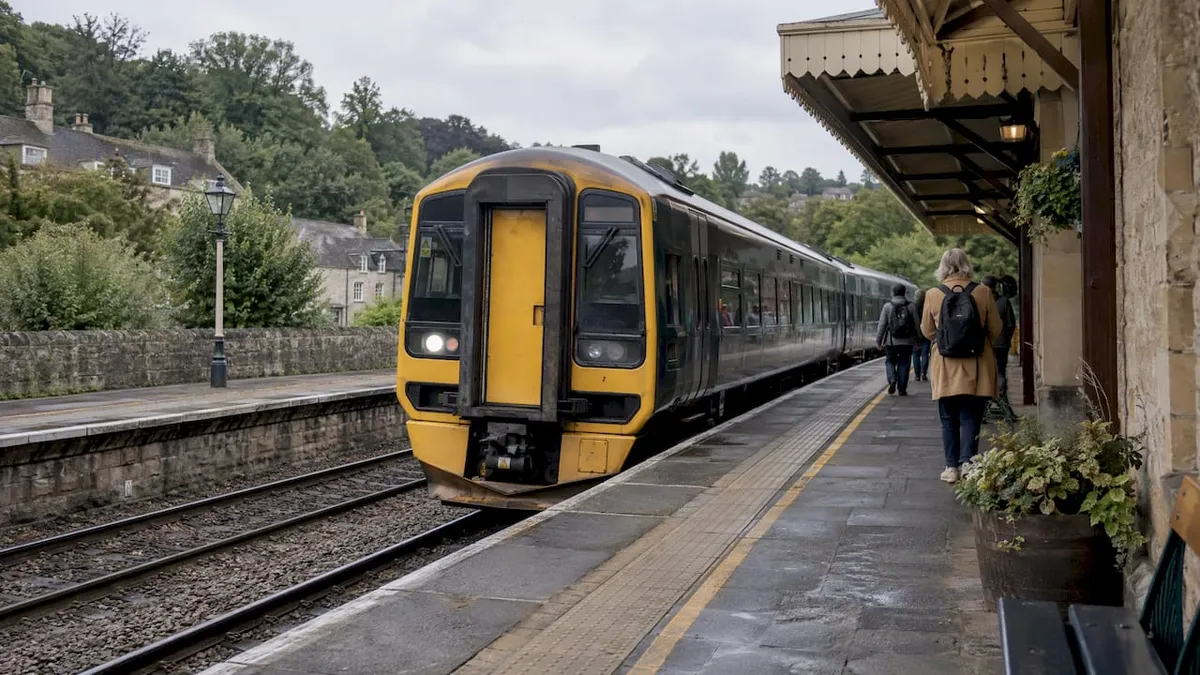
By bus from Chippenham. The two villages are on different routes, both run by Faresaver from Chippenham bus station:
- Castle Combe: the 95 and 95A, a few journeys a day, Monday to Saturday, taking about 25 minutes. The current timetable shows no Sunday service. Check the return times before you go, because missing the last bus leaves you in a village with no station.
- Lacock: the X34 towards Melksham and Trowbridge, roughly hourly in the daytime, taking about a quarter of an hour.
These connections work, but they turn a short hop into most of a day once you add waiting and the walk from the stop. Bus timetables change, so confirm each one before you travel. Our guide to the Cotswolds without a car covers the bus network further north.
Three sample itineraries for a day out
Pick the version that matches your transport and your appetite for driving on narrow lanes.
Southern villages by car
- Leave Bath in good time, ideally before 9am on a weekend, to get a parking space.
- Spend an hour or so in Castle Combe. The car park is above the village and is pay-and-display. Walk down from there, and take care on the lane, which has stretches without a pavement.
- Drive on to Lacock, about 20 minutes away, for lunch and a walk round the village and the abbey.
- If you still have the energy, carry on north to Bibury, about an hour from Lacock, before heading home. Otherwise, call it a day and be back in Bath by late afternoon.
Pro Tip: Castle Combe and Lacock are at their quietest in the early morning, and both get busier from late morning on fine days.
Car-free short option
- Take a morning train from Bath Spa to Bradford-on-Avon.
- Spend two to three hours in the town: the riverside, the medieval town bridge and the 14th-century tithe barn, which English Heritage looks after and which is free to enter.
- For a second stop, go back through Bath to Chippenham and take the X34 bus to Lacock. There is no direct train from Bradford-on-Avon to Chippenham, so this is a long day; check the last bus back from Lacock before you set off.
Family route
- Drive to Cotswold Farm Park near Guiting Power, or Cotswold Wildlife Park near Burford. Both are about an hour and a half from Bath, so this is a full day. Check each park's opening dates and whether it asks you to book before you set off.
- Allow most of a day at the Wildlife Park, or a few hours at the Farm Park.
- If time allows, add a short village stop nearby: Bourton-on-the-Water is close to the Farm Park, and Bibury lies on the way home from the Wildlife Park.
Our guide to family days out in the Cotswolds has more on both parks.
Stonehenge and the Cotswolds in one day
Stonehenge is not in the Cotswolds; it lies south-east of Bath on Salisbury Plain. Combining the two is possible, but it means a long day with a lot of time on the road, so it works best as a guided tour. Leave Bath early, visit Stonehenge first, then go on to one or two villages before returning in the evening.
Guided tours from Bath: shared, private and combined Stonehenge trips
A guided tour takes the planning and the driving away, which suits a first visit, a solo trip, or anyone who would rather not drive narrow lanes. Shared minibus tours usually leave Bath in the morning, stop at several villages and return in the late afternoon or evening. Private tours cost more but let you choose the stops and the pace. Operators, routes and prices change from season to season, so this guide does not name any. Check what is running for your dates.
Tours that add Stonehenge run longer than village-only trips. Stonehenge entry is by timed ticket, and English Heritage recommends booking ahead, so check whether the tour includes the ticket or leaves it to you.
Before booking any operator, check:
- The exact start and finish points in Bath, and what time you get back.
- Which villages it stops in, and how long you get in each one.
- The maximum group size.
- Whether entry fees (Stonehenge, Lacock Abbey) and lunch are included or extra.
- The cancellation policy.
- Whether the vehicle and the stops suit anyone in your party who needs step-free access.
Planning checklist: timing, tickets, parking and costs
A little preparation turns a good day trip into a smooth one.
Leaving times: On a weekend, aim to leave Bath before 9am to beat the traffic and get a parking space.
Tickets: The National Trust looks after Lacock Abbey, the Fox Talbot Museum and much of the village. The abbey and museum need a ticket unless you are a member, and the Trust's main car park is a short walk from the village. Check the Trust's page for current opening times and prices. For Stonehenge, book a timed ticket in advance. For family attractions in the school holidays, check whether booking is required.
Parking: Castle Combe's car park is pay-and-display, above the village. Bibury has no dedicated visitor car park, and the county council has been bringing parking there under a traffic management plan, so check the current arrangements rather than assuming free roadside space.
Accessibility: Village pavements are often narrow, uneven or missing, which can be awkward for pushchairs and wheelchairs. Check each venue's own website for step-free access where it matters to your group.
Mobile signal: Coverage dips between villages, so save tickets, bus times and directions before you set off.
Money and food: Book lunch at popular pubs at weekends, and carry a card and some coins, because payment methods vary.
Where to eat: dining and picnic spots along the way
Village pubs are the obvious choice for lunch, and booking ahead matters most in Castle Combe and Lacock at weekends. Chippenham, the market town between Bath and those two villages, has a wider choice if you want a quicker meal.
For a picnic, the riverside in Bradford-on-Avon is an easy spot close to the station. Buy supplies in Bath before you set off, since village shops are small and choice is limited. A packed lunch also means you're not tied to a reservation time.

Whichever you choose, build in a buffer. Rural pubs can be slow to serve on a busy Saturday.
Travelling with children or pets
Children generally do better with one or two stops than a packed itinerary. The family route built around Cotswold Farm Park or Cotswold Wildlife Park works because it gives them space to run around rather than another village to walk through. Both parks publish their facilities and opening times on their own websites, so check buggy access and baby-changing before you go.
If you're travelling with a dog, many pubs and some attractions welcome dogs, but ask each venue rather than assume. Keep dogs on a lead near livestock, and bring water, since not every stop has an obvious source on a warm day.
For both children and dogs, plan more breaks than you would for an adults-only trip.
Weather and what to pack
The weather can change quickly, so a light waterproof is worth packing even on a fine day. Village streets are often uneven, so comfortable, sturdy shoes matter more than they would for a city day out.
Summer weekends bring busier villages. A weekday visit, or a trip in spring or early autumn, usually means quieter streets and easier parking. Layers work best, since mornings can be cool even when the afternoon warms up.
History and character in each village
Castle Combe is often described as one of England's prettiest villages: a single street of stone cottages running down a wooded valley to a stream and a packhorse bridge, with a market cross at the top.
Lacock is best known for Lacock Abbey, a medieval abbey that became a country house after the Dissolution, and for William Henry Fox Talbot, the photography pioneer who lived there. The village has appeared in many films and television dramas.
Bradford-on-Avon prospered on the woollen cloth trade, and its stone houses climb the hillside above the river. Its tithe barn is older than the cloth boom: a 14th-century monastic barn.
Bibury is known for Arlington Row, the row of stone cottages that is one of the most familiar views in the Cotswolds.
Each rewards a slow look rather than a rushed photo stop, which is why fitting more than two or three into one day tends to leave visitors feeling they saw less than they hoped.
A realistic day beats trying to see everything
Choose a guided tour if you're unsure about narrow lanes or limited parking, and drive yourself if you're comfortable on unfamiliar country roads. Either way, picking one main activity, whether that's a farm park, an abbey or simply wandering two villages properly, makes a better day than chasing five stops.
Arrive at your first village early if you can. The streets are quieter and parking is easier before the day visitors arrive.
Plan your day with The Cotswolds App
The Cotswolds App is a free web guide to thousands of places across the region. Its listings are built from open map data and published after review.
For a day out from Bath, these are the useful parts:
- The map shows places by category, including car parks, pubs and public toilets, so you can see what is near each stop.
- Near me lists what is closest to you once you arrive.
- Area guides, such as Lacock, Chippenham and Corsham, gather the places around each town or village. Place pages show opening hours where we hold them.
- If you sign in, you can save your stops as an itinerary, and download the directory and map to your phone for places with no signal. Do the download on wifi before you leave.
- Place pages show visitor ratings, including a dog-friendly rating, where someone has left a review. Most places have no reviews yet.
It is a web app, not a store download. The install page shows how to add it to your home screen.
Sources
- Bradford-on-Avon station: facilities and accessibility · National Rail
- Timetables · Great Western Railway
- Faresaver 95/95A Chippenham to Castle Combe timetable · bustimes.org (operator open data)
- Faresaver X34 Chippenham to Lacock and Trowbridge timetable · bustimes.org (operator open data)
- Lacock Abbey, Fox Talbot Museum and Village · National Trust
- Bradford-on-Avon Tithe Barn · English Heritage
- Tickets at Stonehenge · English Heritage
- Bibury traffic management plan · Gloucestershire County Council