
Cotswolds in Spring: What to See, Where to Walk and When to Go
12 November 2026Last checked 12 November 2026
Spring in the Cotswolds starts with snowdrops in late winter and ends with bluebells in May. In between come daffodils, blossom, new lambs and lighter menus in the pubs. The villages are usually quieter than in high summer, although Easter and bank holiday weekends are busy. The season is best enjoyed on foot, with a garden or two and a long lunch. This guide covers what flowers when, where to go, and how to plan around opening times.
TL;DR
- Spring here runs from late January to May. Snowdrops are generally at their best from late January through February, and the Woodland Trust says most bluebells flower in April, with some woods at their best in May.
- Pick your month by flower: snowdrops first, then daffodils, then blossom, then bluebells.
- Gardens, arboreta and farm attractions suit changeable weather. Walks and villages suit the dry days.
- Opening days change each year, and some snowdrop gardens must be booked ahead, so check each garden’s own page before you set off.
- Use the Cotswolds map to see gardens, walks and lunch stops near each other.
Table of Contents
- The Cotswolds spring calendar: what flowers when
- Gardens and arboreta worth planning around
- Villages that suit spring
- Spring walks and bluebell woods
- Lambs, farms and family days
- Spring events to look for
- What to eat in spring
- Planning your trip
- Plan your spring days with the app
- Sources
The Cotswolds spring calendar: what flowers when
The season is long and it moves with the weather. A mild winter brings everything forward, and a cold one holds it back. Treat the months below as a rough guide, not a promise.
| Highlight | Usual timing | Best for |
|---|---|---|
| Snowdrops | Late January through February | Quiet gardens, short winter walks |
| Daffodils | Usually March | Woodland paths, parkland |
| Blossom | Usually late March and April | Gardens, arboreta, village lanes |
| Bluebells | Mostly April, into May | Woodland walks |
| Lambing | Late winter into spring | Family days out |
For snowdrops, Painswick Rococo Garden says its display is usually at its best in late January into early February. For bluebells, the Woodland Trust says they usually flower from late March to early May, with most flowering in April. Some Cotswold woods are at their best in May, so the exact weeks shift from wood to wood and year to year.
Which month should you choose?
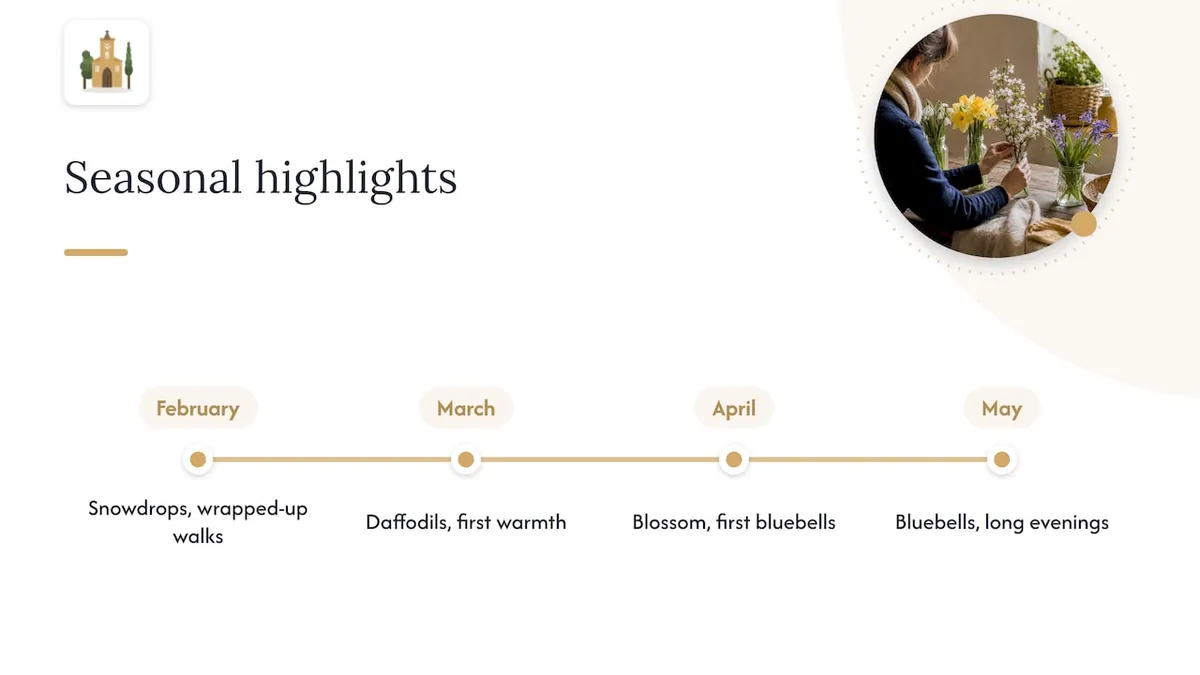
February is for snowdrops and wrapped-up walks. Our guide to snowdrops in the Cotswolds and when to book covers the best-known displays.
March brings daffodils and the first hint of warmth. More gardens reopen for the season during the month.
April is a good all-round choice for blossom and the first bluebells. Most gardens are open by then, and the Easter holidays bring families out.
May brings bluebells in many woods, long evenings, and bank holiday weekends with events and busier roads.
Gardens and arboreta worth planning around
Gardens are a safe spring choice, because they are easier to enjoy between showers than an exposed hillside. For more on pairing them, read our guide to Cotswold gardens to visit.
Batsford Arboretum, near Moreton-in-Marsh
Batsford’s own website promises “early colour from the snowdrops, followed by spring-flowering bulbs and spectacular Japanese flowering cherries”. It lists opening from 9.30am to 5pm Monday to Saturday and 10am to 5pm on Sundays, with last entry into the arboretum at 4pm. Hours can change, so check before you drive.
Painswick Rococo Garden
This Rococo garden was laid out almost 300 years ago in a hidden valley, a short walk from the centre of Painswick. It is best known for its snowdrops, and visits in February must be booked online in advance. It then opens daily through its main season, with the current hours and dates on its visit page. Our guide to the area around Painswick helps with the rest of the day.
Hidcote Manor Garden
Hidcote, near Chipping Campden, is described by the National Trust as an “Arts and Crafts-inspired garden, a network of ‘outdoor rooms’”. Its National Trust page lists current opening times and prices. Winter and main-season arrangements differ, and the main season usually starts in March, so check the page for the day you plan to go.

More gardens for early spring
Snowdrop collectors may like Cotswold Farm at Duntisbourne Abbots, near Cirencester, which the National Garden Scheme lists with a snowdrop collection of over 80 varieties. It is a private garden, so check its open days or arrange a visit with the owners first.
Near Tetbury, the King’s private garden at Highgrove opens only for pre-booked visits. Highgrove’s tours page lists Spring Walks on selected dates in March and April, and Garden Tours on selected dates from April to September. Dates are released each year, so check the page before you plan around it.
Villages that suit spring
Bourton-on-the-Water, Bibury and Lower Slaughter can feel crowded in summer. Outside the Easter and bank holiday weekends, March and April are usually calmer, and you can often stroll through them at an easy pace.
- Bibury: Arlington Row is a terrace of cottages owned by the National Trust. The Trust says it is believed to date from around 1380, when it was a monastic wool store, and it became weavers’ cottages in the 17th century. The cottages are lived in, so there is no public access to them or their gardens; enjoy them from the path.
- Broadway: A wide high street of golden stone. The walk up to Broadway Tower adds views and fresh air. Our guide to the area around Broadway has more.
- Chipping Campden: The start of the Cotswold Way, and a good base for the bluebell walk below. See our guide to the area around Chipping Campden.
If you want a quieter pace, our guide to romantic Cotswolds villages and a two-day loop picks out the calmer corners.
Spring walks and bluebell woods
Spring is at its best on foot. A good walk can be an hour along a river or a day on the Cotswold Way. Two well-documented bluebell spots:
- Lynches Wood, below Dover’s Hill, near Chipping Campden. The Cotswold Way’s Chipping Campden and Dover’s Hill circular walk describes “the area’s finest show of bluebells in May” in Lynches Wood. The full loop is 4½ miles (7.2km), rated moderate with some steep sections, and the wood has a boardwalk over a muddy stretch. A shorter 3-mile route avoids the climbs but does not go through the wood.
- Foxholes Nature Reserve, about four miles north of Burford. The Berks, Bucks and Oxon Wildlife Trust says Foxholes is “awash with bluebells” in May. Dogs must be kept on a lead.
Stick to the paths in bluebell woods. The Woodland Trust asks visitors to avoid picking or trampling the flowers.
Spring is also lambing time in the fields. The Countryside Code says it is good practice to keep your dog on a lead around livestock wherever you are. Between 1 March and 31 July you must keep your dog on a lead on open access land, even if there is no livestock, and the Code asks you not to disturb birds that nest on the ground. It also asks you to stay on marked paths, even when they are muddy.
The ground is often wet in March and early April, so wear proper boots. Field paths can be waterlogged after rain. Near me lists the places closest to where you are standing, which helps when you want a walk or a café nearby.
Lambs, farms and family days
Lambing makes spring a good time for a family visit. Cotswold Farm Park at Temple Guiting runs a lambing and kidding season each spring. Its lambing page says the event returns in February 2027, with talks each day at 11am and 2.30pm, and ewes ranging “from Kerry Hills and Herdwicks to the local Cotswold breed”. It also lists Lambing After Dark evenings on selected dates in February and March 2027, which must be booked in advance. Check the farm’s own site for the full season dates.
A few ways to fill a family day:
- A morning at the farm park.
- A picnic or pub lunch in a nearby village.
- A short riverside walk to let the children run off energy.
- A rainy-day backup, such as a museum or gallery in a nearby town. The directory lets you search by category and distance.
Spring events to look for
Two big dates fall in late spring.
- Badminton Horse Trials. Held on the Badminton Estate in South Gloucestershire in early May. The organisers list Wednesday 5 to Sunday 9 May 2027.
- Cooper’s Hill Cheese Rolling. Traditionally held at Brockworth, near Gloucester, on the late May bank holiday. It is unofficial and unmanaged: the organised event was cancelled in 2010, and since then it has gone ahead informally in most years (it was called off in 2020 and 2021 during the pandemic), with no official organiser, no ticketing and no safety plan. Tewkesbury Borough Council’s Safety Advisory Group has judged it unsafe because no plans for keeping the public safe have been submitted, and has asked anyone thinking of going to “consider the risks”. Anyone who goes, to watch or to take part, does so at their own risk.
Both bring crowds and busy roads, so book accommodation early. Our events calendar lists charity and community events across the region.
What to eat in spring
Spring menus turn lighter and greener. Look out for wild garlic, purple sprouting broccoli and, later in the spring, British asparagus on pub and restaurant menus.
A spring day often ends at a country pub. The Inn for All Seasons, on the A40 at the Barringtons near Burford, is one example in the app. If you are travelling with a dog, check the dog-friendly rating on each place’s page where visitors have left one, and ask the pub before you go.
Planning your trip
Spring weather is changeable, so pack layers and a waterproof. A morning can start frosty and end in sunshine. Plan around three things.
- Opening times. Many gardens and attractions run reduced days early in the season and extend as spring goes on. Check each venue’s own page for the day you plan to go.
- Booking. Weekends, Easter and the May bank holidays fill up first. Book accommodation early, and book gardens that ask for it, such as Painswick Rococo Garden in February and Highgrove.
- Getting around. A car makes village-hopping easier. If you travel by train, plan a base near a station and check bus times for onward journeys. Rural services can be thin, especially on Sundays.
A simple rule helps: put one garden or farm in the morning, a village at lunchtime, and a walk in the afternoon. That leaves slack for the weather.
Plan your spring days with the app
The Cotswolds App puts villages, pubs, gardens, shops, places to stay and attractions on one map. Use it to line up a garden, a walk and lunch within a short drive of each other. The directory lets you search by name and filter by category and distance, and place pages show sheep, accessibility and dog-friendly ratings where visitors have added them. If you sign in, you can save stops to an itinerary and see them on a map.
You can also install the app on your phone to keep it to hand while you explore.
Sources
- When do bluebells flower?, Woodland Trust
- Snowdrops, Painswick Rococo Garden
- Plan Your Visit, Painswick Rococo Garden
- Batsford Arboretum
- Hidcote, National Trust
- Cotswold Farm, National Garden Scheme
- Tours, Highgrove Gardens
- The historic Arlington Row cottages, National Trust
- Chipping Campden and Dover’s Hill circular walk, Cotswold Way National Trail (PDF)
- Foxholes, Berks, Bucks and Oxon Wildlife Trust
- The Countryside Code, GOV.UK
- Lambing and Kidding, Cotswold Farm Park
- Lambing After Dark, Cotswold Farm Park
- General information, Badminton Horse Trials
- Multi-agency statement ahead of cheese rolling event, Tewkesbury Borough Council