
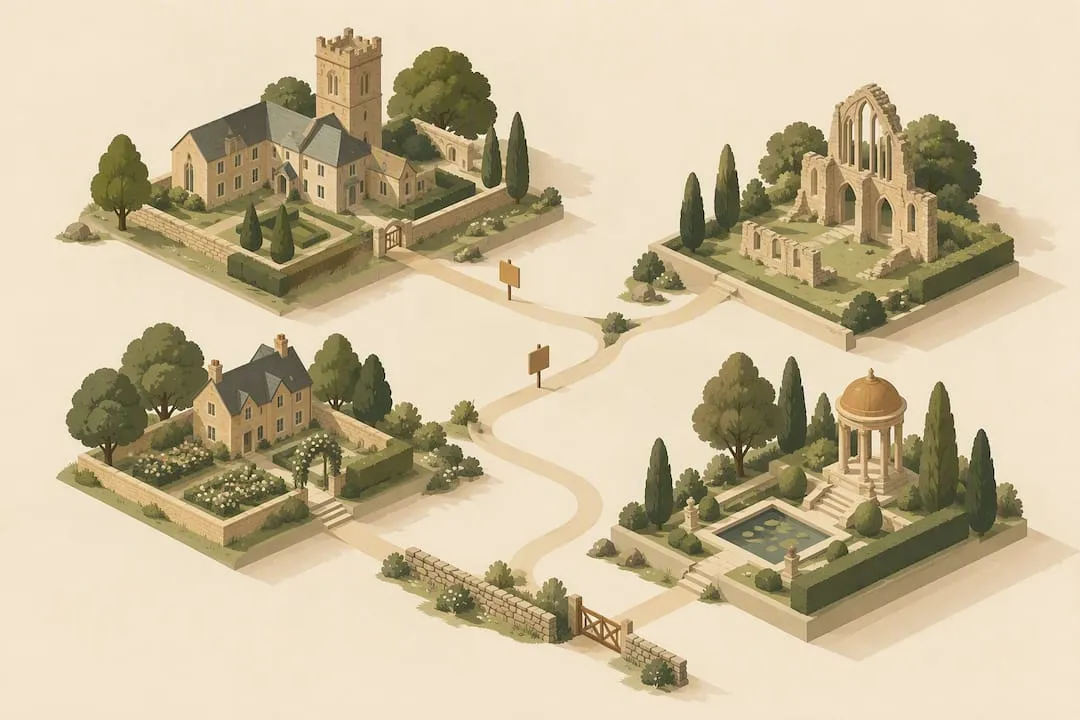
Start with Hidcote, Snowshill Manor, Newark Park and Arlington Row at Bibury: between them a garden that changed English gardening, a collector’s crammed manor, a Tudor hunting lodge and the most photographed row of cottages in England. Be realistic about reaching them, though. Three of the four are genuinely awkward without a car, and the Trust’s own pages say so — the car-free options in the Cotswolds are real, but they are mostly at other properties, listed further down.
TL;DR:
- Most Cotswolds National Trust sites accept walk-up visits, but checking the specific property’s page before travel helps avoid queues on busy days.
- Parking at Newark Park and other rural sites can be challenging; arriving early and verifying directions through official pages prevents access issues.
- Public transport options are limited, especially in winter or at remoter sites, making advance planning for buses or taxis essential to stay on schedule.
- Combining short walks with garden visits is feasible using the Cotswold Way, but proper footwear and weather preparation are necessary for muddy or uneven paths.
- Membership covers entry to over 500 National Trust places and parking at most Trust car parks, but not Bibury’s (not Trust-run) or Newark Park’s (charged).
Table of Contents
- Which National Trust places in the Cotswolds are worth visiting?
- How do you get to these National Trust sites?
- Walking routes that connect the Cotswold sites
- Visitor etiquette and access notes worth knowing
- Planning tools that make visits easier
- Public transport timetables and ticketing
- What facilities can you expect at each site?
- What do entry fees and membership cover?
- Where can you stay overnight nearby?
- A quick, practical visit plan worth copying
- Plan your National Trust days with The Cotswolds App
- Sources
Which National Trust places in the Cotswolds are worth visiting?
Each of these sites offers something different, so your choice really depends on what draws you outdoors in the first place.
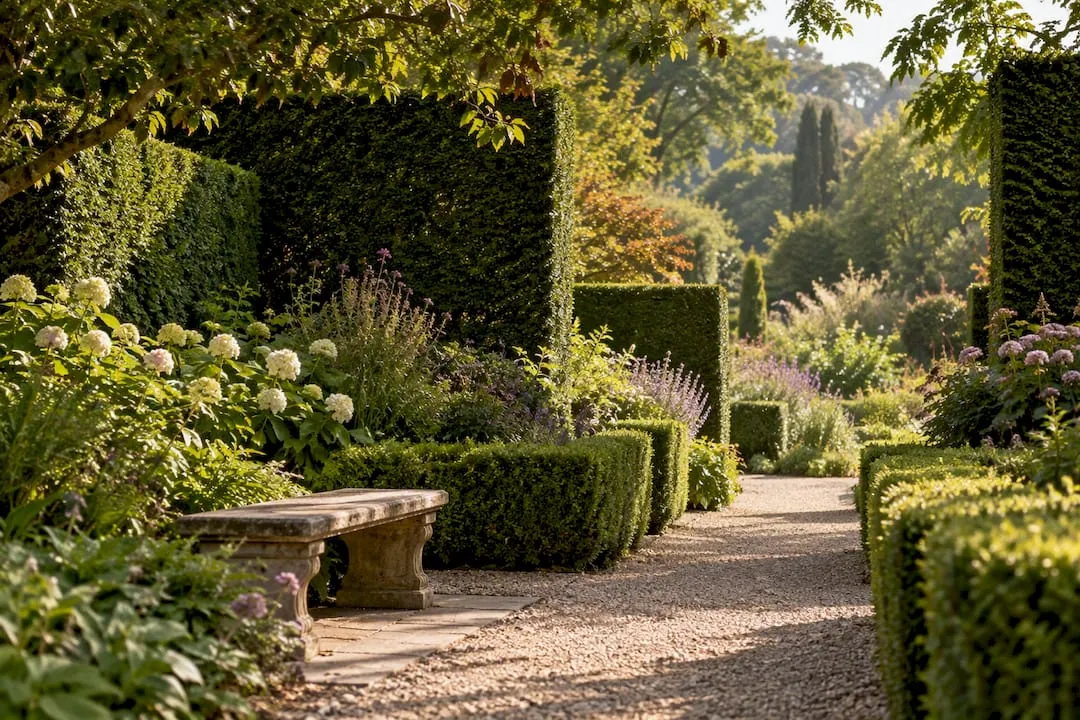
Hidcote tops most lists for good reason. Major Lawrence Johnston, an American-born plantsman, began making it in 1907 and gave it to the National Trust in 1948 — the first property the Trust ever took on for its garden alone, saved through a fund set up with the RHS for the purpose. Its series of “garden rooms”, Grade I registered, remain one of the most influential pieces of horticultural design in England. Wander through hedged enclosures that shift in mood and colour as you move, from formal borders to a wilder, more naturalistic stretch near the boundary. The garden team keeps a careful balance between structure and untamed planting, which is part of what makes a visit here feel different every season.
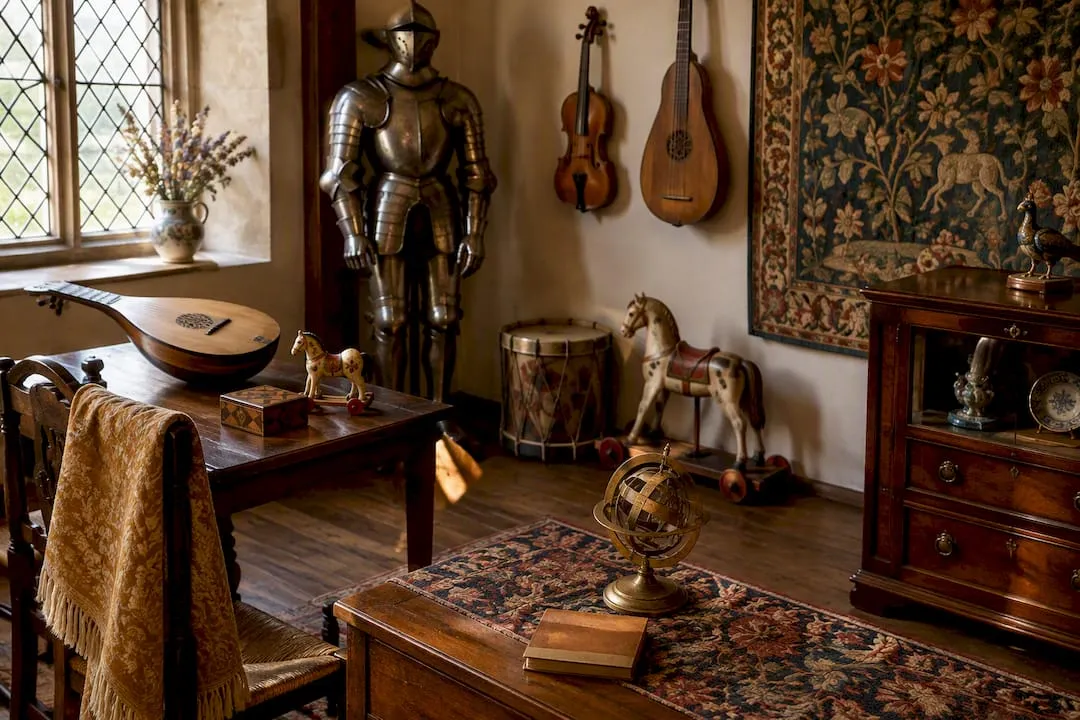
Snowshill Manor rewards visitors who enjoy a story as much as a view. Charles Wade gave over every room of the manor to more than 20,000 objects — musical instruments, armour, Samurai suits, toys, textiles — and lived himself in the small cottage opposite, now the Priest’s House. Nothing is labelled and the rooms are deliberately dim, left arranged as Wade had them rather than rehung as a museum. Allow two to three hours rather than one: the manor is a 500-metre uphill walk from the car park, entry is by timed ticket, and there is the Arts and Crafts terraced garden and the Priest’s House besides. The Cotswold Way runs three-quarters of a mile away.
Newark Park is a Tudor hunting lodge — built for Sir Nicholas Poyntz in the 1540s, four storeys and startlingly symmetrical — remodelled into a square Georgian house by James Wyatt around 1790, with 700 acres running out towards the Severn Vale. Its own visitor notes are blunt: do not use your SatNav, because it will take you up a very steep single-track lane. Follow the brown signs from the Wotton-under-Edge mini-roundabout instead. Note too that parking is charged here, which is unusual for a National Trust site.
Arlington Row at Bibury is the postcard image most people carry of the Cotswolds before they arrive. Worth being precise about what the Trust owns: the row itself and Rack Isle, the boggy water meadow opposite — not the village, which has no National Trust visitor centre, admission charge or car park. The row went up around 1380 as a monastic wool store and was only converted into weavers’ cottages in the late 17th century, so the buildings are two centuries older than the weaving. Rack Isle is named for the racks the finished cloth was hung on to dry; it is a wildfowl reserve now, grazed in late summer by Belted Galloway cattle. The cottages are let to tenants, so there is no public access inside — except that numbers 1 and 9 are Trust holiday lets, which is the only way to sleep in one.
A few smaller stops deserve a mention too:
- Chedworth Roman Villa is a destination rather than a detour — allow an hour or two. There is no public transport to it at all, and the approach is on narrow single-track lanes, so follow the brown “Roman Villa” signs rather than signs to Chedworth village.
- Westbury Court Garden is worth knowing about, but it is not in the Cotswolds: it sits on the Severn floodplain near Gloucester, west of the escarpment, and turns up on Cotswolds lists only because the Trust’s administrative region is called “Gloucestershire and the Cotswolds”. Go anyway if formal gardens interest you — it is England’s only restored Dutch-style water garden, laid out from 1696, and the Trust’s first garden restoration.
How do you get to these National Trust sites?
Getting there sensibly matters as much as choosing where to go, particularly once you’re off the main roads and onto the lanes that thread through this landscape.
Here is the honest position, taken from the Trust’s own arrival pages. Hidcote has no direct bus; the nearest stop is Mickleton, followed by a steep mile-and-a-half uphill footpath, and Honeybourne station is four and a half miles away with no taxi rank. Snowshill is two and a half miles uphill from the nearest buses at Broadway. Newark Park states plainly that there is no bus stop within about 150 metres of the site. Only Bibury is genuinely straightforward, on the hourly Pulhams 855 from Cirencester — and Bibury is the one that is not a National Trust property.
It is worth reading those SatNav warnings for what they are, too: a lane too steep and narrow for a satnav route is a sign that a place is hard to reach by car, not evidence that it is easy to reach without one.
If you are travelling car-free, these National Trust places in the Cotswolds actually work: Crickley Hill, an Iron Age hillfort on the Cotswold Way with buses from Cheltenham; Woodchester Park, a wooded valley of lakes near Stonehouse station; Dyrham Park, reachable by bus from Bath and Bristol; and Hailes Abbey near Winchcombe, close to the Cotswold Way and the steam railway. Gloucestershire’s bookable Robin minibus also covers Snowshill and Bibury, which is the practical way to reach Snowshill without a car.
Newark Park is the site that most reliably catches drivers out. Its own arrival notes warn visitors not to rely on SatNav, since some access lanes are steep, narrow or single-track. The same caution applies more broadly across rural Cotswold lanes, where a satnav route that looks fine on screen can turn into a tight squeeze between stone walls.
For a smoother day out:
- Check the official property page for arrival directions rather than trusting your device alone.
- Check opening times rather than assuming an early start helps: Hidcote’s garden opens at 10am, but Snowshill does not open until 11am, and its manor tickets are issued on arrival for timed slots that can run out on a busy day.
- Pack for changeable weather, layers, waterproofs, and sturdy shoes for uneven paths.
- Confirm parking payment methods in advance, since some rural car parks are card-only or app-based.
Pro Tip: For remoter properties like Snowshill Manor, local bus services can run infrequently, so it’s worth booking a taxi in advance rather than hoping one turns up on the day.
Walking routes that connect the Cotswold sites
The Cotswold Way runs for 102 miles through this landscape, and you don’t need to walk the whole trail to benefit from it. Short sections pass close to several National Trust properties, making it easy to pair a garden or house visit with a proper walk in the same day.
A few sample routes to consider:
- Short (2 to 3 hours): Explore Hidcote’s garden rooms, then take a gentle circular walk through nearby fields back to the car park or bus stop.
- Half-day: Combine Snowshill Manor with a Cotswold Way stretch towards Broadway Tower, stopping at a village pub for lunch along the way.
- Full day: the seven-and-a-half-mile circular from Wotton-under-Edge through Tyley Bottom, Ozleworth and Newark Park — a Cotswold Gateways route rather than part of the Cotswold Way — finishing with tea in the estate café. It starts in Wotton-under-Edge, which has buses from Stroud, Gloucester, Bristol and Yate, so it doubles as the best car-free way to reach the house.
Wear proper walking shoes rather than trainers, since Cotswold paths turn muddy fast after rain. If you’re relying on public transport, check return times before you set off, since rural bus services can be sparse later in the afternoon.
Visitor etiquette and access notes worth knowing
A little awareness goes a long way here, particularly at sites where real people still live.
- Arlington Row’s cottages are private homes, not museum exhibits, so avoid trespassing onto doorsteps or lingering with cameras pointed at windows.
- Dog policies vary by property. Gardens often welcome dogs on leads, but house interiors and some garden areas restrict them, so check ahead.
- Accessibility varies considerably across these rural sites. Uneven paths and gravel are common, so check each property’s official accessibility page before visiting.
- Opening times and café hours shift seasonally, so confirm them on the official page rather than assuming a summer schedule holds all year.
Planning tools that make visits easier
The National Trust’s own pages remain your first stop for anything official, including sustainable travel options and the regional Gloucestershire and Cotswolds overview, which lists car-free routes and things to do nearby.
Once you know which National Trust site you’re heading to, The Cotswolds App helps you fill in the gaps around it:
- An interactive map covering thousands of places across the region, from villages to viewpoints.
- Category filters across pubs, cafés, walks and campsites, plus dog-friendly ratings left by other visitors — useful if you're travelling with a well-loved spaniel in tow.
- Trip-planning tools that let you string together a National Trust visit with a nearby pub lunch or overnight stop.
A sensible workflow: check the official property page for access and opening times first, then use the app to plan what happens either side of your visit.
Public transport timetables and ticketing
Rural bus and rail services around the Cotswolds run to their own rhythm, often thinner on Sundays and considerably reduced outside the summer season. Most National Trust properties list their nearest station or bus stop on their individual property page, along with a rough walking distance from there, so check this before booking travel rather than after.
Tickets for buses and trains covering the region are generally available on the day, though booking ahead online often saves a few pounds on rail fares. If you’re combining several stops in one day, a day-rover or similar multi-journey ticket can work out cheaper than paying for each leg separately, though availability depends on the specific operator covering your route.
Timetables change with the seasons, and some rural services scale back significantly in winter. Always check the current timetable shortly before travelling rather than relying on information from a previous visit, since Sunday and bank holiday services are the most likely to differ from weekday patterns. If you’re relying entirely on public transport for a full day combining two or three sites, build in a buffer of at least 30 minutes between connections. Missing one bus on a route that only runs hourly can unravel an otherwise well-planned itinerary quickly.
What facilities can you expect at each site?
Most of the larger properties, Hidcote, Snowshill Manor and Newark Park among them, offer a café or tearoom, toilets, and a small gift shop stocking local produce, plants and National Trust branded goods. Expect these to be seasonal in their opening hours, particularly at smaller sites, with reduced service or full closure common through the winter months.
Bibury is a slightly different case. As a village rather than a single managed property, its facilities are spread across local pubs, tearooms and shops rather than concentrated in one National Trust building. This actually works in your favour if you’re travelling with family, since you have more choice of where to stop for lunch or a toilet break without committing to one specific café.
Gift shops at the house properties tend to lean into their own story: expect eccentric curiosities echoing Snowshill’s collection, or gardening books and plant sales reflecting Hidcote’s horticultural reputation. None of these facilities are guaranteed to be open every day of the week outside peak season, so a quick check of the property’s own page before travelling saves disappointment, especially if lunch is riding on it.
What do entry fees and membership cover?
Entry fees vary by property and change periodically, so the current price for Hidcote, Snowshill Manor or Newark Park is always best confirmed on the specific property page before you travel rather than assumed from a previous visit. What stays consistent is the value of National Trust membership for anyone planning to visit more than one or two sites across a trip.
Membership grants free entry to over 500 National Trust places and free parking at most — though not all — Trust car parks, which adds up quickly if you’re touring several Cotswold gardens and houses across a long weekend. Two exceptions matter on this list: Bibury’s car parks are not National Trust at all, and Newark Park charges for parking. Family membership options exist too, covering named adults and their children, which tends to work out more economical than paying individual entry fees for a group.
If you’re only visiting once, a single adult ticket at the property gate remains simple and requires no advance booking at most sites. For repeat visitors, particularly locals who might drop into Hidcote across different seasons to watch the garden change, membership pays for itself faster than a one-off day ticket price might suggest.
Where can you stay overnight nearby?
Villages like Chipping Campden, Broadway and Bibury itself offer a good spread of overnight options within easy reach of the main National Trust sites, from traditional coaching inns to smaller bed and breakfasts tucked behind honey-coloured stone frontages. Staying centrally in one of these villages cuts down significantly on driving time between sites the next day.
If camping or a caravan pitch suits your trip better, several sites across the wider region cater well to walkers wanting an early start on the Cotswold Way, and planning a camping stay in advance means you can pick a pitch close to whichever cluster of National Trust properties you’re prioritising. Booking ahead matters more than you’d think here, particularly through summer weekends when the region’s popularity with both walkers and day-trippers pushes local accommodation to capacity fast.
A quick, practical visit plan worth copying
Arrive at Hidcote for opening, before the coach parties do. By midday, drive or walk to a nearby village for lunch, then pick up a short Cotswold Way stretch in the afternoon sun. Visit midweek if you can, check the weather forecast the night before, and use the planning tools above to fill any gaps in your route.
Plan your National Trust days with The Cotswolds App
Once you’ve picked your National Trust sites, the harder part is filling in everything around them, the pub that actually takes dogs, the car park that isn’t full by 10am, the walking route back that doesn’t retrace your steps. A regional app can be built precisely for that gap: an interactive map covering thousands of places across the region, filterable by category, so you're not scrolling through five separate websites to build one day out.
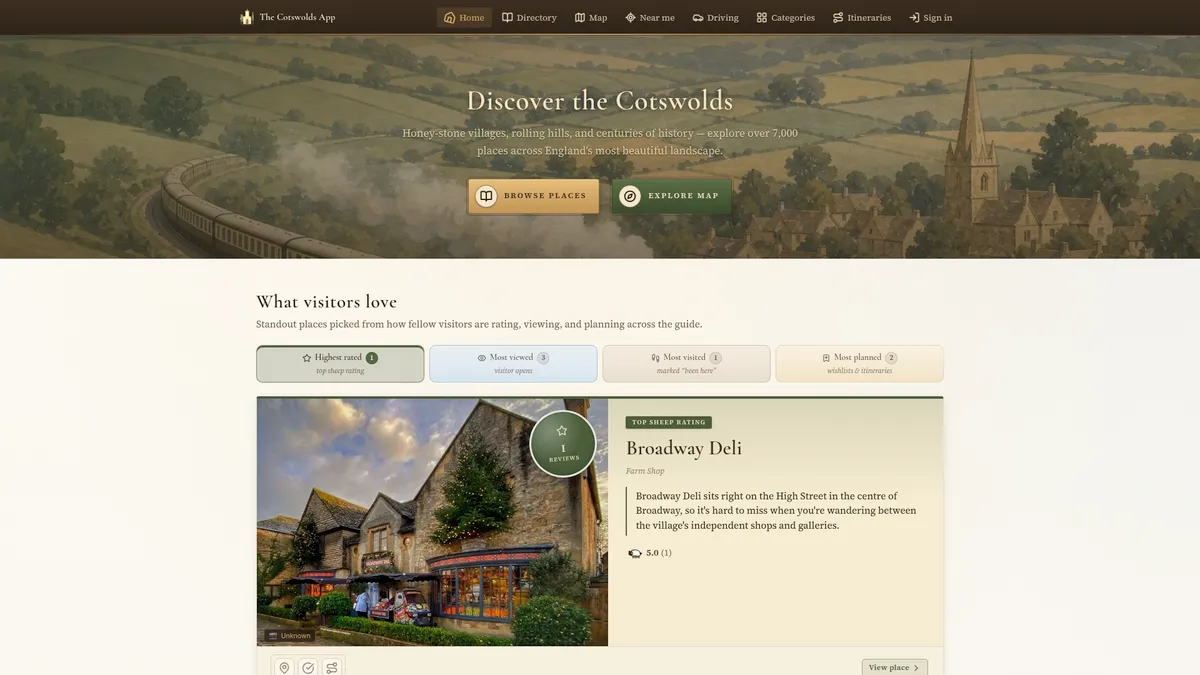
Try this: open the Cotswolds map, search for Hidcote or Bibury, then save a nearby pub with a lead-free garden area and a car park that won’t fill by mid-morning. Save them to a list and you’ve got a day sorted in minutes rather than hours of separate searching. Head to the map now and start building your own route around the Cotswolds’ best National Trust places.
Sources
- Sustainable travel in Gloucestershire and the Cotswolds | National Trust
- The history of Hidcote | National Trust
- Booking your visit to Snowshill Manor | National Trust
- Newark Park | National Trust
- Things to do in Bibury | National Trust
- The Robin bookable bus | Gloucestershire County Council