
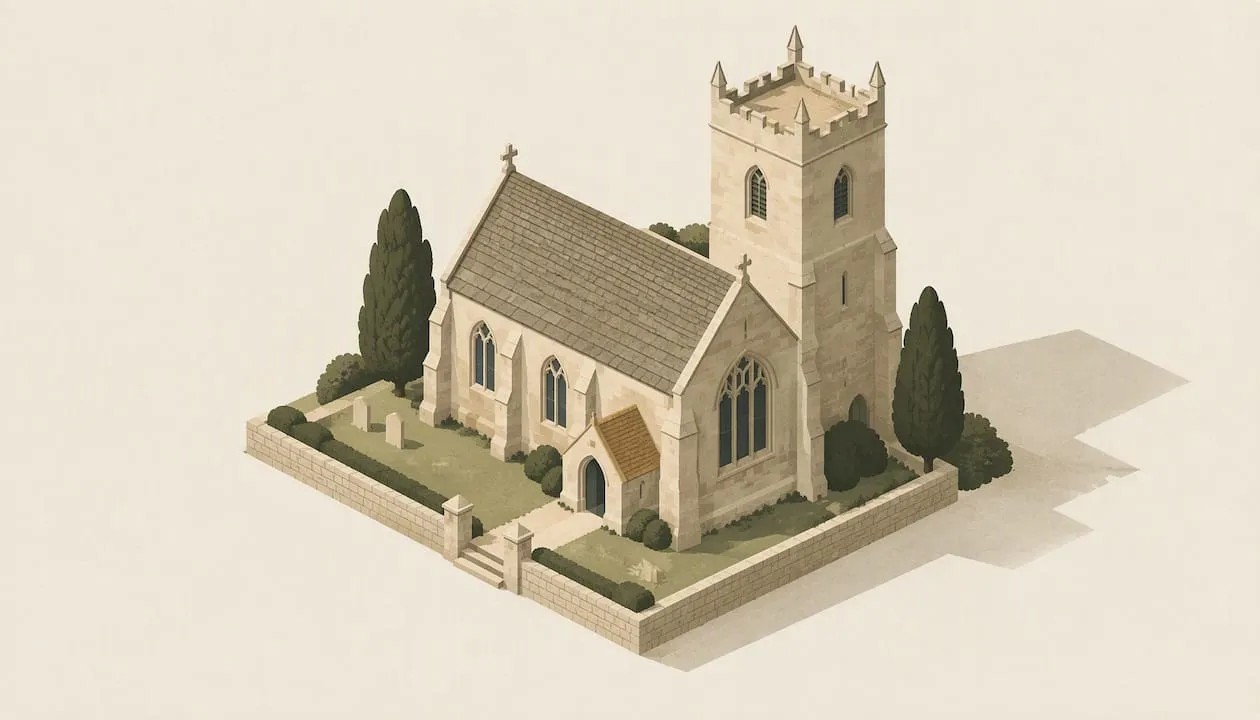
The Cotswold wool churches are the grand parish churches of small market towns, rebuilt on a startling scale with money from the medieval wool trade. If you only have time for four, head to Cirencester, Northleach, Chipping Campden and Fairford. Each shows you something different: sheer size, carved stone and merchants’ brasses, a famous wool merchant’s memorial, and a remarkably complete set of medieval stained glass.
This guide explains what a wool church actually is, how to read one when you step inside, and how to fit them into a relaxed day among the honey-stone villages.
TL;DR
- “Wool church” is a modern label for prosperous parish churches rebuilt or enlarged, mostly in the Perpendicular style, in the late Middle Ages.
- Start with four: St John the Baptist in Cirencester, St Peter and St Paul in Northleach, St James in Chipping Campden and St Mary’s in Fairford.
- Look down as well as up: merchants’ brasses in the floor, some showing their feet resting on a sheep or a woolpack, are among the best finds.
- These are working parish churches, so check for services before you go, especially on Sundays, and expect shorter hours at smaller churches.
- Pair an architecture stop with an art stop, and build in time for lunch or a short walk between them.
Table of Contents
- What is a wool church?
- Four wool churches to see first
- How to read a wool church
- Planning your visit
- Beyond the big four
- Choosing which churches to see
- Plan the day with the app
- Sources
What is a wool church?
The phrase sounds like an official category, but it isn’t one. Great British Life calls it “a term of modern invention rather than a formal group”. These were the parish churches of well-off wool towns, many of them rebuilt or enlarged in the Perpendicular style during the 15th century.
Perpendicular is the style that gives these churches their lightness: tall windows, slender piers and a sense of height that can surprise you in a small town. Many have a handsome west tower too, and some have lavishly decorated porches.
The idea is not unique to the Cotswolds. Wikipedia’s entry on wool churches describes them as churches financed mainly by donations from rich merchants and farmers who had profited from the medieval wool trade, and its lead example is Long Melford in Suffolk. But the Cotswolds, with its sheep-grazing hills and good building stone, is where many visitors meet them first.
Who actually paid for them?
It is tempting to picture a single rich merchant buying his way into heaven. The reality was broader. Architectural historian Dr Nicola Coldstream, quoted by Great British Life, says these parish churches “were almost always communal efforts, with the entire parish chipping in”. Wool money mattered a great deal, but a church like this was a parish-wide undertaking, not one man’s project.
The building boom did not last. Wikipedia notes that the building of wool churches largely ended with the English Reformation, at around the same time as the wool trade declined.
Four wool churches to see first
These four make a manageable introduction, and each is known for something different.
| Church | Town | Known for |
|---|---|---|
| St John the Baptist | Cirencester | Its size; dubbed the Cathedral of the Cotswolds |
| St Peter and St Paul | Northleach | Wool merchants’ brasses and a pinnacled south porch |
| St James | Chipping Campden | The brass of wool merchant William Grevel |
| St Mary’s | Fairford | 28 pre-Reformation stained glass windows, made 1500 to 1517 |
St John the Baptist, Cirencester
Cirencester’s church is dubbed the Cathedral of the Cotswolds, though it has never been a cathedral. The National Churches Trust calls it the largest of the Cotswold wool churches. Its richly decorated three-storey south porch, dating from about 1490, faces straight onto the Market Place, so you can combine a visit with coffee, shopping and a wander through the town.

Plan at least an hour. There is a lot to take in, including tombs and chapels, and the scale rewards slow looking. The National Churches Trust says the church is open every day and runs tours, with the tower opened on special days. When you have finished, our Cirencester page lists pubs, walks and things to do nearby, and the things to do around Cirencester guide shows what is within easy reach.
St Peter and St Paul, Northleach
For many people this is the one. The south porch is the first thing that stops you: pinnacles, carvings and statues, though some of the statues are now missing. The National Churches Trust suggests looking up at the vaulting inside it.
Historic England’s listing describes the church as rebuilt in the 15th century, largely at the expense of the wool merchant John Fortey, who also has a memorial brass here. UK South West’s profile of the church puts the start of the work at around 1380, with the west tower, and says its brasses rank among the best in the country. The oldest is thought to commemorate Thomas Adynet, who died in 1409.
Northleach is small and walkable, which makes it ideal for a slow visit. Our things to do around Northleach guide shows places to eat and wander once you have seen the church.
St James, Chipping Campden
St James stands at the end of Chipping Campden’s honey-stone High Street. Its best-known memorial is the large brass in the chancel to William Grevel, who died in 1401, described on it as “the flower of the wool merchants of all England”, and his wife. In the south chapel is the grand marble monument to Sir Baptist Hicks, a 17th-century London silk mercer rather than a wool man. Brasses are sometimes kept covered to protect them, so ask if you cannot see it.
Chipping Campden is also a good base for a longer day. Our half day in Chipping Campden covers Arts and Crafts, gardens and Dover’s Hill, and the Chipping Campden page lists pubs and walks. If you are staying longer, the things to do around Chipping Campden guide widens the net.
St Mary’s, Fairford
Fairford is the art stop. The church’s own page says it holds a complete set of 28 pre-Reformation stained glass windows, made between 1500 and 1517 under the direction of Edmund Tame, son of the wool merchant John Tame who rebuilt the church. It calls them “probably the most complete set of medieval stained glass in Britain”. The windows run in sequence through the Bible story, and following them in order is part of the pleasure.
Fairford lies on the southern side of the Cotswolds, a few miles west of Lechlade. Our things to do around Fairford and things to do around Lechlade guides are useful if you want a riverside walk or lunch afterwards.
How to read a wool church
Once you are inside, a few details will turn a pleasant visit into a memorable one.
- The brasses. Engraved memorial plates set in the floor commemorate wool merchants and their families. At Northleach some show the merchant’s feet resting on a woolpack or a sheep, a proud advertisement of how he made his money.
- The height and light. Perpendicular windows are large and tall, so the interior feels open. Notice how the stonework draws your eye upward.
- The porch. In some churches the porch is the showpiece. Cirencester’s three-storey porch and Northleach’s pinnacled one are the classic examples.
- The tombs and memorials. These record who was prosperous, and sometimes who they married and where they traded.
- The glass. Fairford is exceptional, but look at windows everywhere. Much medieval glass was lost after the Reformation, so any that survives is worth a closer look.
Planning your visit
Check before you go
The four churches in this guide are generally open to visitors, but they remain active parish churches. Check the church’s own website or noticeboard for services and events, particularly on Sundays, and bear in mind that smaller village churches may keep shorter or seasonal hours than the major landmarks.
Avoid arriving mid-service as a sightseer. If a service is on, come back once it has finished.
What to wear and how to behave
You don’t need special clothing in an English parish church, but a quiet voice, a silenced phone and respect for anyone praying go a long way. Photography is usually fine, but ask if you are unsure, and avoid flash near old glass and painted surfaces.
A simple one-day circuit
The four churches are spread across the region, so don’t try all of them in one day unless you enjoy driving. Thinking in pairs works well: set a church known for its architecture, such as Northleach, beside one known for its art, such as Fairford.
Here is a relaxed way to do that:
- Start in Northleach in the morning. Give the church an hour, then look around the town.
- Drive on towards Fairford for lunch.
- Spend the afternoon with the windows at St Mary’s.
- Finish with a short walk by the river, or a drink before heading back.
On another day, combine Cirencester with Chipping Campden if you are happy to drive, or treat them as separate half-days.
Best times to go
Weekday mornings are generally quietest, and autumn has a particular charm when the stone glows against changing leaves. Winter days are short and some smaller churches close earlier, so go early. Summer is lovely but busy in the most photographed towns.
Beyond the big four
There are plenty of other fine churches across the region. One easy addition on the road north from Cirencester is All Saints in North Cerney, which Historic England’s listing dates to the early 12th century, with alterations in nearly every century since.
Not every old Cotswold church is a wool church in the strict sense, but they share the same landscape and stone. Visiting one or two is a lovely way to spend an afternoon between the headline stops.
Choosing which churches to see
Choose one or two churches, not six, and give each real time. The best visits are rarely the ones with the longest checklist. They are the moments when you sit quietly in a nave, notice a merchant’s sheep underfoot, and realise how much a small town once meant.
Pair every church with something ordinary and enjoyable: a pub, a bakery, a short walk. That’s how you get the feeling of the place, not just the facts about it. Out of season, the churches are quieter and you will have more space to look.
Plan the day with the app
Once you have chosen your churches, the Cotswolds map shows pubs, cafés, villages and walks around them, and each town’s area guide lists what is nearby. If you are already out and about, Near me shows what is closest to where you are standing. For a wider look at the region, see our list of top Cotswolds attractions, or start from The Cotswolds App itself.
Sources
- Exploring the legacy of the Cotswolds ‘Wool churches’, Great British Life
- Wool church, Wikipedia
- St John the Baptist, Cirencester, National Churches Trust
- St Peter and St Paul, Northleach, National Churches Trust
- Church of St Peter and St Paul, Northleach, Historic England list entry
- Church of St Peter and St Paul, Northleach, UK South West
- Church of St James, Chipping Campden, Historic England list entry
- The stained glass windows of St Mary’s Church, Fairford, A Church Near You
- Church of All Saints, North Cerney, Historic England list entry