
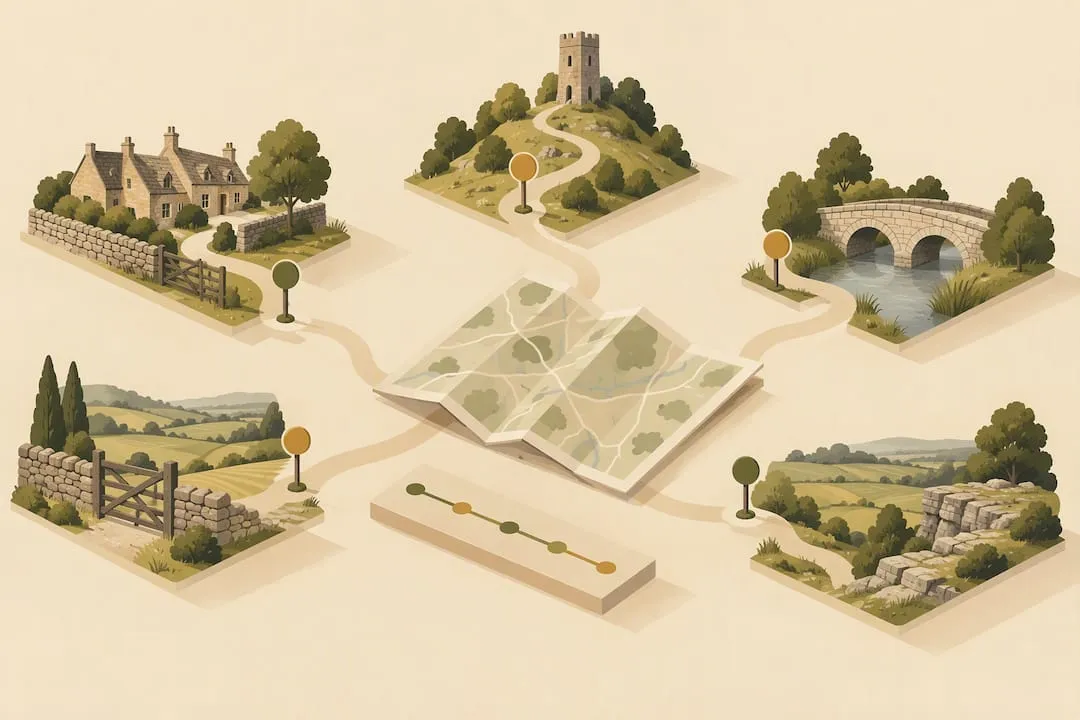
Five dependable dog walks in the Cotswolds are Bourton-on-the-Water to the Slaughters for an easy village walk, the Broadway Tower loop for the view, Woodchester Park for woodland and lakes, Cleeve Common for open grassland, and Bibury to Coln St Aldwyns for a stile-free river valley. All five share the same catch: sheep and cattle graze on or beside every one of them, so knowing the lead rules matters as much as knowing the route.
TL;DR:
- Bourton to the Slaughters is short and gentle, but it crosses sheep meadows and has plenty of gates.
- The Broadway Tower loop is about 4 miles, now stile-free, and dogs must be on a lead in the country park because of its red deer herd.
- Woodchester Park has a National Trust café that welcomes dogs, and cattle and sheep in its fields.
- Cleeve Common has cattle all year and sheep from late April to late November, and from 1 March to 31 July the law requires a lead of no more than 2 metres there.
- Don't let dogs swim at Bibury: the River Coln there is private trout fishing.
Table of Contents
- 1. Bourton-on-the-Water and the Slaughters
- 2. Broadway Tower loop
- 3. Woodchester Park: woodland, lakes and a dog-friendly café
- 4. Cleeve Common and Leckhampton Hill: open grassland with cattle
- 5. Bibury and Coln St Aldwyns: a stile-free river valley
- 6. Two more worth knowing
- 7. Dogs, livestock and the law
- 8. Before you go
- 9. Using The Cotswolds App for a dog walk
- Sources
1. Bourton-on-the-Water and the Slaughters
This is the classic short Cotswolds walk: out of Bourton-on-the-Water to Lower Slaughter, then along the Warden's Way to Upper Slaughter. Between the Slaughters the path follows the little River Eye; the River Windrush runs through Bourton itself.
- Distance: Bourton to Lower Slaughter is roughly a mile and a half, much of it on a lane closed to cars. Lower to Upper Slaughter is about another mile, 20 to 25 minutes on foot. Walking back the same way makes it a gentle half day.
- Livestock: the path crosses meadows where sheep graze, so leads go on at the gates.
- Terrain: easy and mostly level, with gates rather than climbs. The field sections turn muddy after rain.
- Logistics: Bourton has the car parks, cafés and pubs. See the Bourton-on-the-Water area guide for what is nearby.
Bourton is busiest from late morning to mid-afternoon, so an early start gives you, and your dog, a much quieter path.
2. Broadway Tower loop
National Trails publishes this as a Cotswold Way circular walk: about 4 miles (6.5 km) from Broadway High Street up to Broadway Tower and back, taking 2.5 to 3 hours. It is rated moderate, with steep sections on the climb out of the village.
- Stiles: National Trails says the route is now stile-free, after improvements. Expect kissing gates instead, which can mean lifting a small dog through.
- Deer: Broadway Tower Country Park has a herd of red deer, so dogs must be on a lead there. Dogs are welcome at the cafés' outdoor seating but not inside the Tower's museum.
- Parking: the official route starts from the village car parks. For a shorter walk, Fish Hill Picnic Place on the escarpment has free parking for about 20 cars, a height barrier and toilets. The Tower's own car park charges.
- Afterwards: Broadway's High Street has several pubs and cafés, and some have outdoor tables.
Pro Tip: The escarpment catches wind that Broadway village never feels. Take a layer, and a towel if the fields are wet.
3. Woodchester Park: woodland, lakes and a dog-friendly café
Woodchester Park is a wooded valley near Stroud, run by the National Trust, with a chain of lakes and waymarked trails. The Trust's own boathouse walk is about 3¾ miles, and there are shorter options from the car park.
- Lead rules: the National Trust asks for short leads on the play trail and in fields with sheep or cattle, and allows long leads on woodland tracks where there is no livestock. Leads stay on around Tinkley Gate at all times.
- Cattle: Welsh Black cattle graze the pasture. The Trust's advice is that if cattle approach you, let your dog off the lead and move away.
- Café: the café at Tinkley Gate has outdoor seating and some indoor space for dogs, with water bowls and dog biscuits.
- Parking: the National Trust car park charges non-members.
The unfinished Victorian mansion in the valley is Woodchester Mansion, which is run by a separate charity, the Woodchester Mansion Trust, rather than the National Trust. Check its own opening days if you want to see inside.
4. Cleeve Common and Leckhampton Hill: open grassland with cattle
Cleeve Common, above Cheltenham, reaches about 330 metres at Cleeve Hill, the highest point in the Cotswolds. It is the biggest stretch of open grassland on this list, but it is a working common, and that shapes what your dog can do there.
- Cattle all year: the Cleeve Common Trust's Galloway cattle are on the common year-round. They roam freely while the sheep are out and are kept in paddocks in winter.
- Sheep: sheep graze from late April until late November.
- The law: Cleeve Common is open access land, so from 1 March to 31 July dogs must be on a lead of no more than 2 metres, livestock or not, to protect ground-nesting birds. Leads are needed around livestock at all times, and otherwise your dog must be under effective control.
- Why it matters: the Trust says more than 20 sheep a year are lost to dog attacks on the common.
- Parking: use the Quarry Car Park near the golf club entrance. Parking anywhere else inside the common's boundary is an offence.
- Golf: a golf course shares the common. Keep off the greens and tees, and watch for play when crossing fairways.
Leckhampton Hill, on the other side of Cheltenham, is smaller and similar in feel. Cheltenham Borough Council grazes it with cattle and asks visitors to keep dogs under close control.
5. Bibury and Coln St Aldwyns: a stile-free river valley
The Cotswolds National Landscape publishes a "Miles without Stiles" circular between Bibury and Coln St Aldwyns: about 6 miles (9.7 km), roughly three hours, along the valley of the River Coln. Part of it follows a private road near Bibury Court, which is a public right of way.
- No swimming here: the River Coln at Bibury is private trout fishing, including the trout farm and a hotel's private fishing, so keep dogs out of the river.
- Pubs: the route passes pubs in both villages. Some allow dogs in the bar or garden but not in the restaurant, so ask before you go in.
- Livestock: the path crosses grazing fields, so keep leads on where animals are present.
- Crowds: Bibury itself is very busy at Arlington Row, so the quieter half of this walk is the Coln St Aldwyns end.
6. Two more worth knowing
- Painswick Beacon: an Iron Age hillfort above Painswick with wide views. It is a popular dog walk, but Painswick Golf Club plays across the common and cattle and sheep graze it, so keep a lead handy.
- Naunton: a quieter village on the River Windrush a few miles from the Slaughters, useful when Bourton is crowded.
7. Dogs, livestock and the law
These are the rules that apply on every walk above, not just the ones that mention them.
- On a lead around livestock. The Countryside Code says your dog must be on a lead around livestock on open access land, and the Cotswold Way National Trail asks walkers to give livestock a 10-metre berth.
- 1 March to 31 July. On open access land, dogs must be on a lead of no more than 2 metres during the ground-nesting bird season, even where there is no livestock.
- If cattle come at you, let go of the lead. A dog can outrun cattle, and you are safer without it.
- A farmer may shoot a dog that is attacking or chasing livestock, and the owner can be prosecuted.
- Bag and bin it, or take it home.
8. Before you go
- Pack: water and a bowl, poo bags, a towel for muddy paws and a spare lead.
- Flea treatments and rivers: the concern runs the opposite way to what is often said. Spot-on flea treatments wash off a dog that swims and pollute the water. A 2025 study in Veterinary Record found the active ingredients in swim samples up to 28 days after treatment. If your dog swims, ask your vet about alternatives to spot-ons, and keep a recently treated dog out of rivers and lakes.
- Signal: phone coverage drops out in the deeper valleys, so save your route before you set off.
- Timing: early mornings are quieter everywhere, but check the grazing season on commons before assuming a dog can run free.
9. Using The Cotswolds App for a dog walk
The Cotswolds map shows the places on or near each of these walks, including the villages, Woodchester Park, Cleeve Hill and Broadway Tower, alongside nearby pubs and cafés. Where visitors have reviewed a place, its page shows a dog-friendly rating, which is worth checking before you rely on a pub for the end of your walk. Rules can change, so confirm with the venue too.
- Search or browse the map and directory to see what is near your starting point.
- Read the area guides, such as Broadway and Bourton-on-the-Water, for what is around each village.
- Download the map for offline use if you are signed in, from Account → Offline storage, so a valley with no signal does not leave you guessing.
Open the Cotswolds map to find your starting point, or install the app to keep it on your phone.
Sources
- Cotswold Way circular walk 2: Broadway and the Tower — National Trails
- Cotswold Way map and information — National Trails
- Fish Hill Picnic Place — Worcestershire County Council
- Visiting Woodchester Park with your dog — National Trust
- The Cleeve Common Code — Cleeve Common Trust
- Frequently asked questions — Cleeve Common Trust
- Leckhampton Hill and Charlton Kings Common — Cheltenham Borough Council
- Bibury and Coln St Aldwyns, Miles without Stiles — Cotswolds National Landscape
- The Countryside Code — GOV.UK
- Flea treatment residues in swim water — Veterinary Record (2025)