
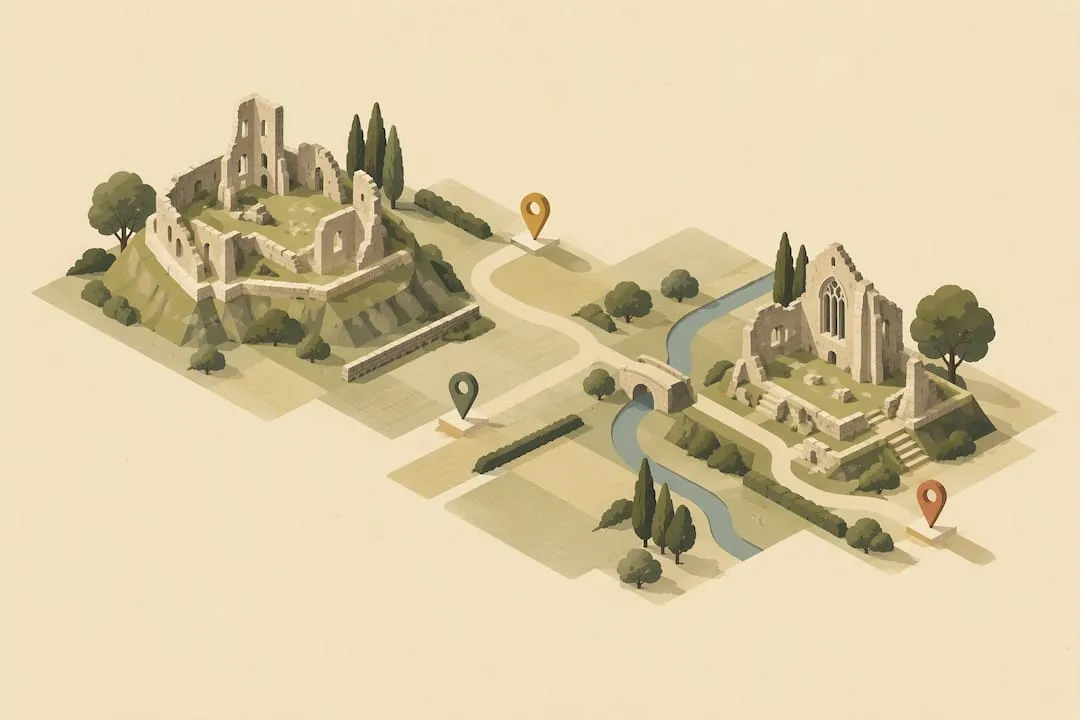
Cotswolds Castle Ruins and Heritage Sites: Which to Visit and How
3 October 2026Last checked 3 October 2026
If you want castle ruins and heritage sites in the Cotswolds, start with Sudeley Castle for its ruined banqueting hall and tithe barn beside a lived-in house, Hailes Abbey for Cistercian remains in open countryside, Minster Lovell Hall for a free riverside manor ruin, Brimpsfield Castle for Norman earthworks on a public footpath, and the Rollright Stones for prehistoric monuments that pair naturally with a castle day out. Practical details on each follow below.
TL;DR:
- Sudeley Castle blends restored rooms with preserved ruins and ten gardens, but it is seasonal, closes for events, and does not admit pet dogs to the grounds.
- English Heritage now opens Hailes Abbey only on the first weekend of each month, booked ahead, and not in winter.
- Minster Lovell Hall is free, open in daylight hours and welcomes dogs on leads; Brimpsfield Castle is earthworks crossed by public footpaths.
- The Rollright Stones are open all year for a small entry fee, with no visitor centre and only two small lay-bys for parking.
- Beverston Castle, often listed as a ruin to visit, is a private home and is not open to the public.
Table of Contents
- 1. Notable castle ruins and heritage sites worth visiting
- 2. Opening times, tickets, getting there and parking
- 3. Ruins versus restored castles: what changes for visitors
- 4. Walks and nearby attractions to pair with a castle visit
- 5. How to plan a castle-ruins day with the Cotswolds App
- 6. Timing and footwear
- 7. Plan your castle-ruins trip with the Cotswolds App
- Sources
1. Notable castle ruins and heritage sites worth visiting
Each of these places offers something different, from an inhabited castle with ruins in its grounds to tumbled abbey walls in a meadow, so the right choice depends on what kind of day you want.
- Sudeley Castle, Winchcombe: a Grade I listed castle with ten gardens across 15 acres, combining restored family rooms with the ruined Banqueting Hall and Tithe Barn, open seasonally.
- Hailes Abbey, near Winchcombe: the low remains of a Cistercian abbey founded in 1246, owned by the National Trust and run by English Heritage, with a small museum.
- Minster Lovell Hall, near Witney: the substantial ruins of a 15th-century manor house beside the River Windrush, free to enter.
- Brimpsfield Castle, between Gloucester and Cirencester: the mound, banks, ditch and gatehouse foundations of a Norman castle slighted in the 1320s.
- Rollright Stones, on the Oxfordshire and Warwickshire border: three prehistoric monuments spanning roughly 2,000 years, a completely different kind of heritage site to break up a day of castle visits.
Sudeley Castle sits at the top of most shortlists for good reason. Katherine Parr, the last of Henry VIII’s six wives, lived and died here and is buried in St Mary’s church in the grounds; the castle describes itself as the only private castle in England with a queen buried within its grounds. The Banqueting Hall, built while Richard III held the castle, and the Tithe Barn were left as ruins after the castle was slighted on Parliament’s orders in 1649. The Worcester glove-makers John and William Dent bought the estate in 1837 and began the restoration that gives Sudeley its mix of lived-in rooms and crumbling stonework, and the Dent-Brocklehurst family still lives there. The official Sudeley Castle site is the place to check before you go.
Hailes Abbey offers a gentler, more reflective stop. Richard of Cornwall founded it in 1246, and a relic said to be the blood of Christ, given in 1270, made it a major pilgrimage destination until Henry VIII’s commissioners dismissed the relic and the abbey surrendered on Christmas Eve 1539. What survives is modest, a few arches and wall footings in a meadow, but the setting below the Cotswold hills gives it a stillness that larger sites rarely manage.
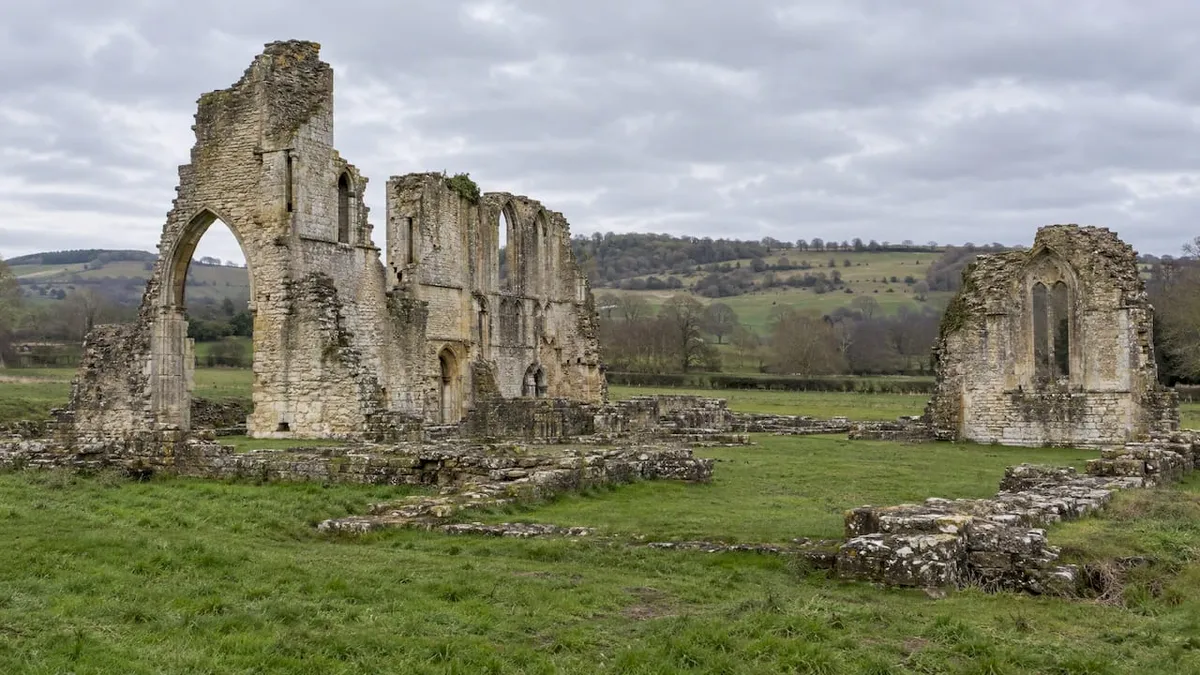
Minster Lovell Hall is the pick for anyone who wants a true ruin to wander. William, Lord Lovell, built the house in the 1430s; Francis, Viscount Lovell, an ally of Richard III, lived here later; and after passing through several hands it was abandoned and largely pulled down in the 18th century. The hall, tower and a separate dovecote stand in a quiet setting by the river next to St Kenelm’s church.
Brimpsfield Castle is for people who like reading a landscape. The Giffard family’s stone castle was slighted after John Giffard rebelled against Edward II and was executed in 1322, and what is left is a mound with an outer bank and ditch and the foundations of a gatehouse in the meadow beside the church. It is a scheduled monument crossed by public footpaths, so it slots into a village walk rather than being a destination in itself.
The Rollright Stones work best as a change of pace rather than a replacement for a castle visit. They are owned and managed by the Rollright Trust, a small charity, not by English Heritage, and the experience is far less formal: no visitor centre, just the King’s Men stone circle beside the road, the single King Stone across it, and the Whispering Knights burial chamber about 500 metres away in the field. The Whispering Knights are the oldest, from the early or middle Neolithic, the circle dates from the late Neolithic or early Bronze Age, and the King Stone is Bronze Age.
One name to strike off your list: Beverston Castle, near Tetbury, appears in many “Cotswold castle” round-ups, but the ruin stands in the grounds of a private house, is inhabited, and is not open to visitors. Its gardens have opened occasionally under the National Garden Scheme, and that is the only way in. Beyond the shortlist, a handful of other sites are worth a quick mention if your route passes nearby. Cirencester’s Roman amphitheatre, for instance, is a worthwhile short stop for anyone curious about the region’s pre-medieval history, even though it sits outside the castle theme proper.
2. Opening times, tickets, getting there and parking
Opening seasons and ticketing vary considerably between sites, so checking the official page before you travel saves disappointment, particularly for family-run estates that close for private events or winter months.
- Sudeley Castle opens daily from mid-March to the start of November (14 March to 1 November in 2026), 10am to 5pm with last admission at 3pm. It closes to visitors on a handful of event days each summer. A 2026 adult ticket was £24. Pet dogs are not admitted to the grounds or gardens, only to the visitor centre and café; assistance dogs are welcome throughout.
- Hailes Abbey has opened only on the first weekend of each month since April 2025, with tickets booked through English Heritage, and is closed through the winter. National Trust members get in free. Outside those weekends the ruins can be seen over the boundary from the Cotswold Way, which passes the site.
- Minster Lovell Hall is free and open in any reasonable daylight hours. Park at St Kenelm’s church, about five minutes’ walk away; parking is not permitted in the lane to the ruins. Dogs on leads are welcome.
- Brimpsfield Castle is open-access earthworks on public footpaths, with roadside parking in the village.
- Rollright Stones are open all year, day and night, for £2 per adult and £1 per child aged 7 to 16, paid online, by QR code on site or in cash at the honesty box. Parking is two small lay-bys on a road busy with lorries, and they fill quickly. Dogs are welcome on leads but not inside the stone circle.
Transport is limited in much of the rural Cotswolds, so driving is the most reliable way to reach most of these sites, with on-site parking at Sudeley and roadside or lay-by parking near the smaller ruins. Public transport reaches the larger towns, such as Cheltenham or Stroud, and the Pulhams 606 bus serves Winchcombe for Sudeley, but it rarely extends to the ruins themselves. Uneven ground, loose stone and unfenced drops are common, so sturdy shoes matter and children need supervision near walls and steps, and exposed sites like the Rollright Stones offer no shelter, so a wet or windy day changes the experience considerably.
A day planned around three or four sites can unravel quickly if one of them turns out to be closed for a wedding or a private function, so check each site’s own page on the day.
3. Ruins versus restored castles: what changes for visitors
A ruin and a restored castle offer genuinely different days out, and knowing the difference helps you set the right expectations before you arrive.
At a restored site such as Sudeley, you get furnished rooms, formal gardens and more structured interpretation: guides, information panels and a café and shop. At a true ruin such as Minster Lovell Hall or Hailes Abbey, there is far less infrastructure. Walls stand open to the sky, floors are grass, and interpretation may be limited to a few signs rather than a full visitor experience.
These limits are not accidental. Ruined sites like these are scheduled monuments or listed buildings, which restricts what can be built, repaired or altered on site. Climbing on unstable walls is generally discouraged or banned outright, both for visitor safety and to protect fragile stonework from further erosion.
Photography is usually welcome and often encouraged, since ruins photograph beautifully in low light, but filming for commercial purposes typically needs separate permission from whoever manages the site, whether that is a family estate, a trust or a charity. It is worth checking this directly with the site rather than assuming a blanket rule applies everywhere, since family-run and trust-managed places tend to set their own conditions.
4. Walks and nearby attractions to pair with a castle visit
Pairing a castle or ruin with a walk or a second heritage site makes for a fuller day without overcomplicating the logistics.
- Sudeley Castle, Hailes Abbey and Winchcombe work well together: Sudeley is a short walk from the town centre, and Hailes Abbey is two to three miles north-east along the Cotswold Way, a relaxed afternoon walk each way.
- Minster Lovell Hall pairs with the thatched village street and a stretch of the Windrush valley; Burford is a few miles upstream.
- Brimpsfield Castle sits on the circular walk through Brimpsfield, Syde and Caudle Green, about four miles, with the Cotswold Way at Birdlip a short drive away.
Timing is the main constraint on multi-site days. Rural roads between sites can take longer than a map suggests, and public transport rarely bridges the gap, so a realistic plan usually means one major site plus one smaller stop, rather than three castles in an afternoon. Building in slack for parking, tea breaks and simply enjoying a ruin without rushing tends to make for a better day than packing the itinerary too tightly.
5. How to plan a castle-ruins day with the Cotswolds App
Sudeley Castle, Hailes Abbey, Minster Lovell Hall, Brimpsfield Castle and the Rollright Stones all have listings in The Cotswolds App, and the interactive Cotswolds map can be filtered by category so that castles, ruins and ancient sites show without everything else.
Once you have found a site, each place page shows what is nearby, so you can judge whether a village or a pub is within walking distance or better reached by car. If you sign in, you can build the day as an itinerary with the stops in order and the driving time between them. Place pages carry a dog-friendly rating where visitors have left one, but most places have no reviews yet, so check the site’s own dog policy before relying on it. The map also works well for finding somewhere to eat afterwards.
6. Timing and footwear
Visit Minster Lovell Hall or the Rollright Stones early in the morning if you can. The light sits low across the stones for a good hour after sunrise, and you will likely have the place to yourself before the first coach parties arrive at the bigger estates.
Wear boots rather than trainers. Ruined floors are often grass over uneven stone, and a damp Cotswold morning turns that combination slippery fast. Pairing a quiet ruin with a busier castle later in the day tends to give the most satisfying balance: quiet reflection first, then the fuller facilities and tea room second.
7. Plan your castle-ruins trip with the Cotswolds App
Planning a day around castles and ruins means juggling opening hours, parking, dog policies and walking distances across several sites with very different management styles. The Cotswolds App brings thousands of places across the region together on one interactive map, so you can filter by category, see what sits near each site and build the day as an itinerary rather than checking five separate websites. Open the map and start building your route.
Sources
- History — Sudeley Castle & Gardens
- Prices & Opening Times — Sudeley Castle & Gardens
- Prices and Opening Times for Hailes Abbey — English Heritage
- Minster Lovell Hall and Dovecote — English Heritage
- Brimpsfield Castle — Wikipedia
- Visiting the Stones — The Rollright Trust
- Rollright Stones — English Heritage
- Beverston Castle — Wikipedia