
Fishing in the Cotswolds: Rivers, Lakes and Day Tickets
28 October 2026Last checked 28 October 2026
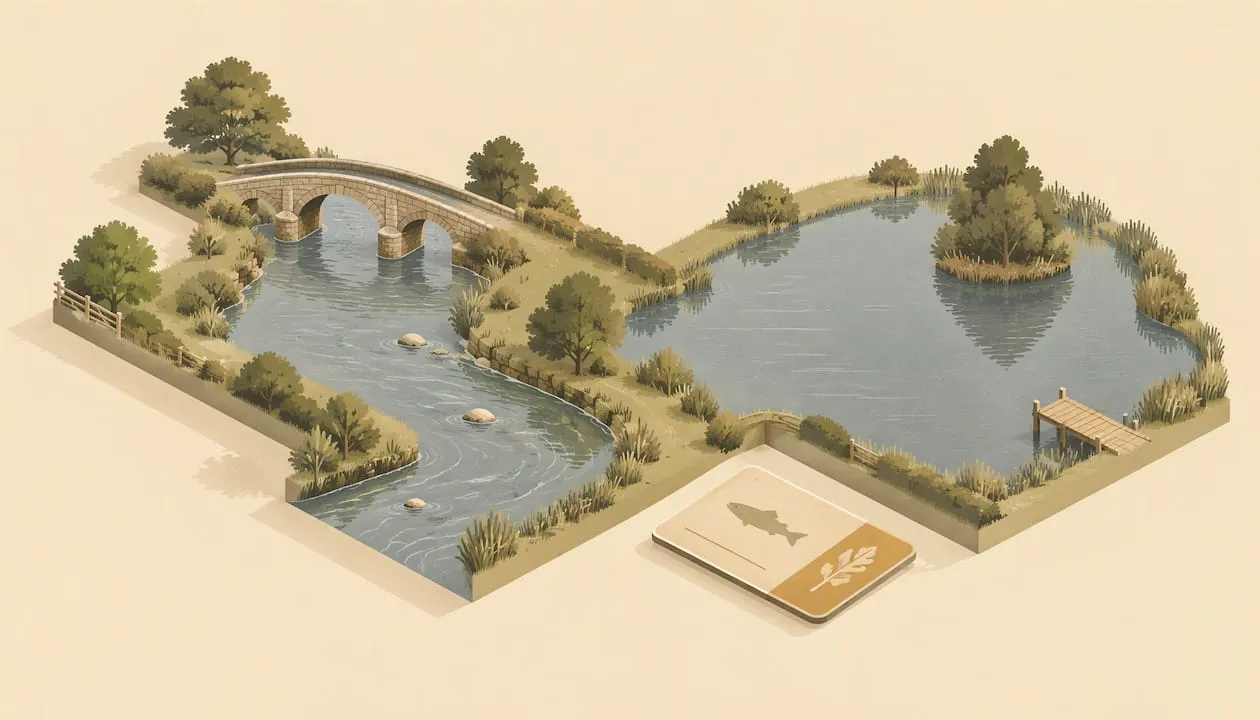
The Cotswolds offers two quite different kinds of fishing. There are clear, gravel-bottomed limestone streams where wild brown trout rise to the mayfly, and there are lakes, many of them old gravel pits, where carp and tench are the draw. Whichever you choose, you will need an Environment Agency rod licence if you are 13 or over, and permission from whoever owns or manages the water. This guide walks you through the options, the rules and the questions worth asking before you set out.
TL;DR
- Rivers: the Coln, Windrush, Churn, Leach and their neighbours hold wild brown trout and, in winter, grayling. Much of the water belongs to clubs and private owners, so sort out access first.
- Lakes: the old gravel pits around the Cotswold Water Park include some coarse fisheries for carp and tench. Each lake is run differently, and many are not fisheries at all.
- Licence: anyone aged 13 or over needs an Environment Agency rod licence (free for 13 to 16-year-olds), plus the fishery’s own ticket, permit or membership.
- Seasons: rivers have statutory close seasons, which differ for trout and coarse fish, so check the dates for the water you are visiting.
- With children: a trout farm that supplies the tackle and shows you how is a far gentler start than a wild river.
Table of Contents
- What kind of fishing can you do in the Cotswolds?
- Trout and grayling on the Cotswold rivers
- Lakes and day-ticket carp fishing
- Fishing with children or as a beginner
- Do you need a licence to fish in the Cotswolds?
- Close seasons: when you can fish
- What does a day ticket cost?
- Planning your fishing trip step by step
- What to bring
- Making a day of it
- Where The Cotswolds App fits in
- Before you go: ask first
- Sources
What kind of fishing can you do in the Cotswolds?
Think of the region as having three kinds of fishing.
Wild trout on small rivers. Cotswold streams are shallow, quick and clear. Cotswold Flyfishers says most of its fisheries have good stocks of wild brown trout, and that the Cotswold rivers are particularly noted for their prolific mayfly hatches. This is dry-fly country, and it rewards quiet, patient anglers who like to watch the water before they cast.
Coarse fishing on lakes and ponds. Gravel extraction left the south of the region, around the Cotswold Water Park, with a patchwork of lakes. Some are coarse fisheries for carp and tench, some are reserved for clubs, and many are nature reserves where fishing is not part of the picture at all.
Family-friendly stocked waters. If you are bringing children, or you have never held a rod, a trout farm that supplies the equipment takes away most of the stress.
If you are searching for trout fishing specifically, keep the rivers and the stillwaters apart in your mind. They have different rules, different seasons and a very different feel.
Trout and grayling on the Cotswold rivers
The Cotswold rivers are not one single fishery. They are a web of small streams, most of them feeding the Thames. Cotswold Flyfishers says its members fish more than 30 miles of bank across 20-plus river fisheries, as well as two small stillwaters. Its Cotswold waters include beats on the Coln, Windrush, Churn, Leach, Dikler and Glyme, and on the Sherborne Brook and Ampney Brook. The club also has water further afield, on the Kennet, the Wiltshire Avon and the Test.
That list is useful even if you never join a club. It tells you which names to look for on a map, and it shows how many small, quiet streams run through villages you may already be planning to visit.

What to expect from the fishing
Wild fish are the point here. They are not large by lake standards, but they are wary and a real test of your presentation.
Cotswold Flyfishers says all its wild trout waters are fished catch-and-release with barbless hooks. Other clubs and estates set their own rules, so always read the conditions on the permit you are given. Note too that the national byelaws allow only one rod at a time when fishing for trout on rivers and streams.
Winter grayling
When the trout season ends, grayling keep the rivers interesting. Cotswold Flyfishers mentions grayling and coarse fishing opportunities across its waters during the winter.
How access works
Many Cotswold river stretches are held by clubs, estates or private owners. You will usually need to join a club, buy a day permit where one is offered, or fish as the guest of a member. Cotswold Flyfishers, for example, says its membership is limited and there is usually a waiting list, though members receive guest tickets. Never fish on the strength of a footpath alone. A public right of way lets you walk. It does not give you the right to cast a line.
Lakes and day-ticket carp fishing
If the rivers are a quiet conversation, the lakes are a more relaxed, sociable affair. The Cotswold Water Park area has many lakes, and each is run differently: some are day-ticket coarse fisheries, some are syndicates or club waters, some are holiday-lodge waters, and some are for wildlife only. Fishery listings and ownership change, so confirm with the fishery itself that it is open to day-ticket anglers before you travel.
A few things separate a good lake day from a frustrating one:
- Check whether it is day-ticket or members only. Search results can blur the two.
- Ask about night fishing. If you plan to stay after dark, confirm it is allowed and what the booking rules are.
- Look at the species. Ask the fishery what the lake holds rather than relying on a listing.
- Check the walking distance. A lake that needs a long barrow-push is a different outing from one with a car park beside the swim.
If you want to see the lake country first, Cotswold Lakes near Ashton Keynes is listed in our directory as a nature reserve, a good place to understand the landscape before choosing where to fish. Check each lake’s signage and rules, because a nature reserve is not a fishery. For a family day beside the water, Cotswold Country Park and Beach at Somerford Keynes is listed as a family attraction.
Fishing with children or as a beginner
There is a real gap between “I’d like to try fishing” and “I’m ready to fish a wild river with a fly rod”. A trout farm with tackle supplied bridges it.
Bibury Trout Farm is one example. Its FAQ page says it supplies the equipment and gives a demonstration, that its Catch Your Own fishing runs at weekends and in school holidays but is weather-dependent so it is worth calling ahead, and that there is a children’s play area. It also says a wheelchair can be taken onto the pontoons on the river, with help from staff. Every fish caught has to be killed and paid for, so this is a catch-and-take-home day rather than catch-and-release. The farm says its own fishing licence covers all its visitors, so by its account you do not need your own rod licence for its Catch Your Own fishing. That is specific to this farm; at other venues, assume you need one unless told otherwise. Check opening times on its site before you go.
A quick checklist for first-timers
- Is equipment supplied, or must you bring your own?
- Is there a minimum age or a need for adult supervision?
- What happens if the weather turns? Is there a refund or rebooking policy?
- Is there somewhere for children to play when they lose interest in the float?
- Is access suitable for pushchairs or wheelchairs?
- Are there toilets and food nearby?
- Do you need your own rod licence, or does the venue’s cover you?
If you are building a whole day around the children, our guide to family days out in the Cotswolds shows how to choose one main activity and let everything else fit around it. Fishing works well as that anchor.
Do you need a licence to fish in the Cotswolds?
Yes, in nearly every case. GOV.UK says that if you are 13 or older you must have a rod fishing licence to fish for trout, freshwater (coarse) fish or eel in England, and that this includes private land such as angling club waters and private fishing lakes. Children under 13 do not need one. You also need permission from the land or fishery owner, usually in the form of a ticket, permit or membership.
That means two separate things:
- The national rod licence, bought from the Environment Agency through GOV.UK.
- Local permission, which is the day ticket, club membership or permit for the specific water.
One does not replace the other. A licence does not let you fish anywhere you like, and a day ticket does not cover you legally without a licence.
What the licence costs
When this guide was checked (October 2026), GOV.UK listed a 12-month trout and coarse licence for up to two rods at £36.80, and a three-rod version at £55.30. Short-term trout and coarse licences cost £7.30 for one day and £14.70 for eight days, which suits a holiday visit. Junior licences for 13 to 16-year-olds are free, but you still need to get one. There are concession rates for people aged 66 or over and for some disabled anglers. Salmon and sea trout need a separate, dearer licence. Prices change, so check the GOV.UK page when you buy.
Keep it with you
Carry proof of your licence whenever you fish. Many anglers save a copy on their phone, but mobile signal in the deeper valleys can be patchy, so save a screenshot before you leave.
Close seasons: when you can fish
This is the part that catches visitors out, especially if they are used to fishing elsewhere.
Rivers have statutory close seasons to protect fish while they spawn. Most Cotswold rivers, including the Windrush, Coln, Churn, Leach and Evenlode, drain to the Thames. For the Thames byelaw area, GOV.UK says that the national coarse fish close season, 15 March to 15 June, applies to rivers, streams and drains. The same page gives a close season of 1 October to 31 March for brown and rainbow trout in rivers, streams and drains, with no close season for brown trout in fully enclosed waters or for rainbow trout in stillwaters.
Put simply:
| Type of water | What the Thames byelaw area rules say |
|---|---|
| Rivers, streams and drains (coarse fish) | Closed 15 March to 15 June |
| Most stillwaters (coarse fish) | No statutory close season, except some SSSI stillwaters listed in the byelaws, which close 15 March to 15 June |
| Rivers, streams and drains (brown and rainbow trout) | Closed 1 October to 31 March |
| Fully enclosed waters (brown trout) | No close season |
| Stillwaters (rainbow trout) | No close season |
Not every Cotswold stream drains to the Thames. Those on the western and northern edges run to the Bristol Avon or the Severn and fall under other regional byelaws, so check the rules for the area your water is in. Because most stillwaters have no statutory close season, lakes are where coarse anglers usually go in spring, but a fishery can still close its own water.
There is one more layer. The Environment Agency’s national byelaw guidance reminds anglers that fisheries may have additional rules. A club might close its river early, ask for barbless hooks only, or limit the number of fish you may take. The ticket in your hand is the rule book for that day.
What does a day ticket cost?
There is no single price. Day tickets on stocked trout waters, on carp lakes and on club river stretches are all priced differently, and they change from season to season. Treat any figure you find on a listings site as a rough guide only, and confirm the price, the hours and the rules on the fishery’s own website or by phone.
A few things usually affect the price:
- Species and stocking. Specimen carp lakes and stocked trout waters tend to cost more than a basic coarse pond.
- Length of session. Day, 24-hour and weekend tickets differ, and night fishing is often priced separately.
- Equipment hire. Where a venue supplies rods, it may be included or charged as an extra.
- Number of rods. Match this to your Environment Agency licence. A two-rod licence will not cover three rods.
Also budget for the extras: bait, a landing net, and the cost of getting there.
Planning your fishing trip step by step
- Choose your style. Wild river trout, lake carp, or a relaxed family session?
- Pick the water. Use our Cotswolds map to see the villages, pubs and places to stay around the area you want to fish.
- Check access. Confirm it is open to visitors, whether you need to book, and how many anglers are allowed.
- Buy your licence. Do this online through GOV.UK before you travel.
- Read the rules. Hooks, bait, catch-and-release, night fishing and any limits on fish taken.
- Check the season. Make sure the water is open on your dates.
- Plan the rest of the day. A pub lunch, a village walk or a family attraction makes the day complete.
What to bring
The legal basics are simple: a rod licence if you are 13 or older, the fishery owner’s permission, and a check of the fishery’s own rules and the area byelaws. Beyond that, a practical kit list looks like this:
- Your licence (on your phone or printed) and your day ticket
- Rods, reels and tackle suited to the water, or confirmation that the venue supplies them
- A landing net and unhooking mat where the rules require them
- Barbless hooks where the rules require them
- Waterproofs and warm layers
- Polarised sunglasses, which help you spot fish in clear river water
- Food, water and sun protection if you will be exposed on a lake bank
- A small first-aid kit and insect repellent for summer evenings
Making a day of it
Fishing is often the quietest part of a good Cotswold day. Once you have your permit sorted, think about what surrounds it.
Our directory’s Fishing category lists fisheries, angling clubs and tackle shops across the region, and the same directory covers campsites, pubs and places to stay. Check with any listing directly about what it offers, as opening times and permits change.
After a morning at the water, you will want somewhere warm to eat. Our Near me page shows the pubs, cafés and villages closest to where you are standing.
Where The Cotswolds App fits in
The Cotswolds App is a free visitor guide to thousands of places across the region. You can open the Cotswolds map, filter it by category, find the village nearest your chosen water, and see where to eat, stay and walk afterwards. Place pages show visitor ratings where people have left them, and you can add your own.
Before you go: ask first
Fishing rewards a little preparation. The two commonest mistakes are arriving with a rod but no licence or permit, and assuming a pretty stretch of river is open to anyone because a footpath runs beside it.
Let the water set the pace. Choose one venue, read its rules properly, and build the day around it rather than trying to fit three fisheries into a weekend.
And if you are not sure whether a spot is open to visitors, ask the club or fishery owner before you set up. A phone call beforehand saves everyone trouble.
Sources
- About Us, Cotswold Flyfishers
- Frequently asked questions, Bibury Trout Farm
- When you need a fishing licence, GOV.UK
- Buy a rod fishing licence, GOV.UK
- Regional rod fishing byelaws: South East (Thames area), GOV.UK
- National rod fishing byelaws for England, GOV.UK