
Wild Camping in the Cotswolds: Why There Is No Right to It, and Where to Stay Instead
3 October 2026Last checked 3 October 2026
There is no right to wild camp in the Cotswolds, and that includes the whole of the Cotswold Way. Pitching a tent without the landowner’s permission is trespass, a civil matter rather than a crime, but the landowner can require you to leave, and the National Trail’s own guidance says plainly that it is not legal to wild camp on the route. The two lawful routes to a night under the stars here are a booked campsite or certificated pitch, or a farmer’s permission asked for in advance. This guide covers both, plus how to keep a night’s impact low.
TL;DR:
- England has no general right to wild camp. The one statutory exception is Dartmoor’s commons, confirmed by the Supreme Court in May 2025; it does not extend to the Cotswolds.
- Camping without permission is trespass, a civil matter, not a criminal offence. You can be told to leave and must go.
- Camping is also prohibited on open access land, which rules out the Cotswold commons such as Cleeve, Rodborough and Minchinhampton.
- Lawful options are commercial campsites, certificated sites (small farm sites run under a club exemption), bunkhouses and B&Bs. Book two to three weeks ahead between May and September.
- Asking a farmer directly works best when you arrive on foot, avoid fields with livestock, stay one night and leave no trace.
Table of Contents
- What the law says about wild camping in England and the Cotswolds
- Permitted places to stay: campsites, bunkhouses and farm pitches
- Certificated and farm pitches: the closest legal alternative to wild camping
- Planning, kit and leave-no-trace essentials for a low-impact night
- How to ask a landowner for permission to camp overnight
- Safety, livestock and timing around lambing season
- How The Cotswolds App helps you find somewhere lawful to stay
- Why lawful, low-impact camping matters here
- Find permitted camping and overnight stays near you
- Sources
What the law says about wild camping in England and the Cotswolds
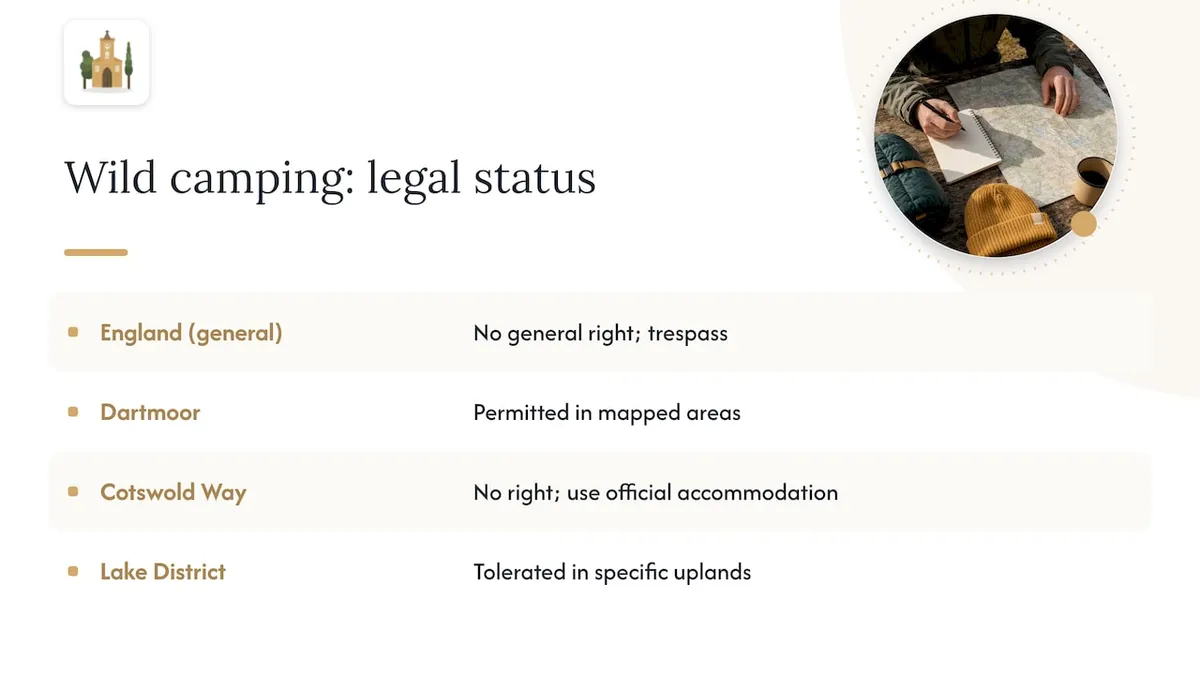
England’s countryside is almost entirely privately owned, and the right to roam created by the Countryside and Rights of Way Act 2000 is a right to walk, not to stay the night: the government’s own guidance on using open access land lists camping among the things you cannot do there. Everywhere else, pitching a tent without asking is trespass. That is a civil wrong rather than a criminal offence, so nobody is arrested for a quiet tent, but the landowner or their agent can require you to pack up and leave, and refusing or causing damage is where it escalates.
Dartmoor is the exception most people have heard of, and since May 2025 it is a confirmed legal right rather than a tolerated habit: the Supreme Court held that the right of access in the Dartmoor Commons Act 1985 includes backpack camping on the commons. The park’s Backpack Camping Code still applies: carry your own kit as part of a walk, stay one or two nights at most, groups of no more than six, no fires or barbecues, at least 100 metres from a road and out of sight of houses, and only in the areas on the park’s map. The authority publishes that map as an open dataset. It is a right created by one Act for one set of commons, and it does not extend to any other national park or National Landscape in England.
The Cotswold Way page on the National Trails site is unambiguous: “it is not legal to wild camp on the Cotswold Way – you will need to stay on official campsites or use alternative accommodation.” The Lake District National Park puts the general position the same way: wild camping is not permitted anywhere without the landowner’s permission, and the tolerance that exists there applies only above the highest fell wall, for one night, with no fires. The Cotswolds has no equivalent uplands, so there is no equivalent tolerance.
Enforcement in the Cotswolds falls to landowners rather than a ranger service, but farmers notice tents in their fields. A verge or lay-by is no better: it is still land you do not own, usually highway land looked after by the council, and a tent or a parked-up vehicle on a narrow lane blocks the road that farm traffic and emergency vehicles rely on. It is not the shortcut it looks like on a map.
Permitted places to stay: campsites, bunkhouses and farm pitches
The good news is that the Cotswolds has plenty of lawful ways to sleep close to nature without the legal grey area. You just need to book ahead, especially in peak walking season.
- Commercial campsites offer the full range, from basic tent pitches to glamping pods, usually with toilets, showers and vehicle access.
- Certificated sites are small farm or private sites, limited by law to a handful of units, run under a camping club’s exemption.
- Farm pitches are a step quieter again: a single field, minimal facilities, and a genuinely rural overnight by arrangement with the farmer.
- Bunkhouses and hostels suit walkers who want a roof and a hot shower without the full cost of a B&B.
- Bed and breakfasts remain the most comfortable option and are plentiful in the villages along the Cotswold Way.
Each type comes with its own trade-offs. A commercial campsite near Chipping Campden might have full facilities and car parking but feel busy in July and August. A farm pitch might mean carrying water in and rubbish out, with no vehicle access at all, which suits walkers more than motorists. Bunkhouses and B&Bs need booking well in advance during the main walking season, particularly around bank holidays.
To find what is actually available nearby, our Cotswolds camping guide maps every campsite in the directory, and the interactive map can be filtered to the campsite category so other listings drop out of view. National Trails keeps its own accommodation listings for the Cotswold Way, grouped into camping and glamping, hostels and bunkbeds, B&Bs, hotels and pubs, and self-catering, which is the place to start if you are walking the trail in stages.
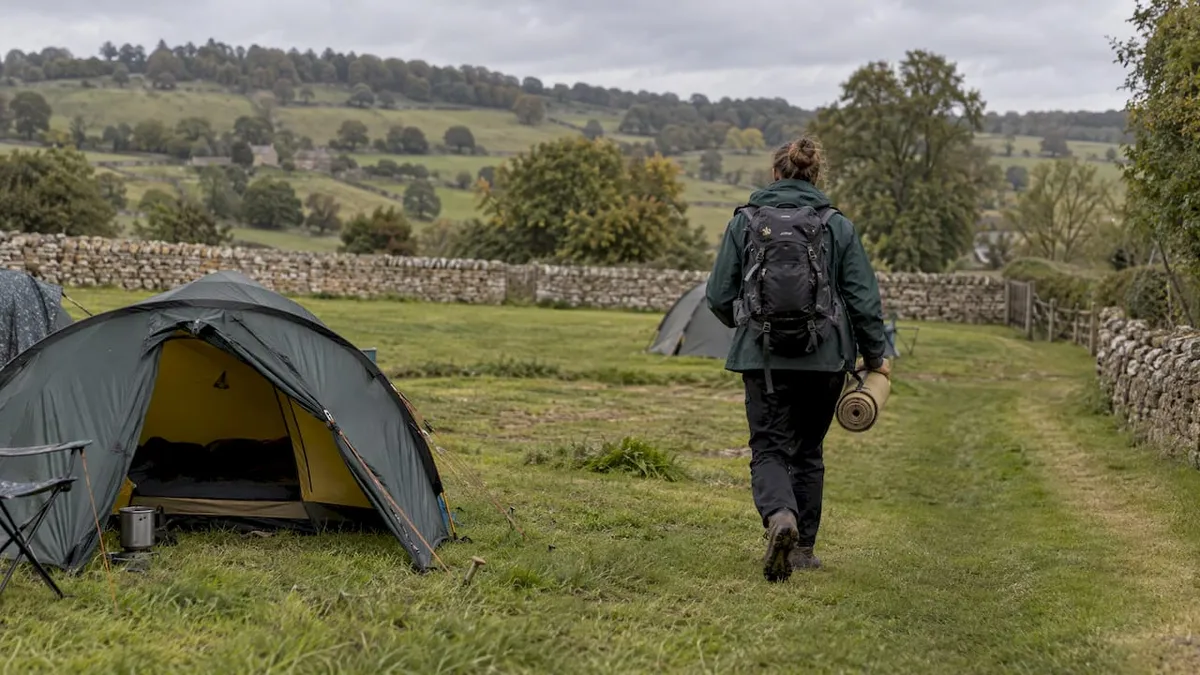
Booking two to three weeks ahead is sensible for anything between May and September. Smaller farm pitches and certificated sites often only have one or two spaces, so they fill first.
Certificated and farm pitches: the closest legal alternative to wild camping
If what you are really after is the feeling of wild camping, a certificated site or small farm pitch gets you closest while staying entirely lawful. These exist because the Caravan Sites and Control of Development Act 1960 lets an exempted organisation, such as the two big camping clubs, certify a piece of land for its members without the site licence a larger campsite needs, as long as no more than five caravans are stationed there; tents come under a parallel exemption in the Public Health Act 1936. Natural England’s guidance on the responsibilities of holding an exemption certificate sets out what the clubs must do in return. In practice that means joining the relevant club to use its certificated sites.
Expect minimal infrastructure: perhaps a water tap, a compost toilet, and a gate rather than a car park. That is the point. The small scale keeps the impact on farmland and habitats low while giving the farm a modest income.
- Single-pitch arrangements are common, often booked directly by phone or email with the farmer.
- Walk-in access is typical, so check in advance whether your vehicle can reach the pitch at all.
- Facilities are basic by design, so bring your own water and waste plan.
These pitches rarely appear on the big booking platforms, so the clubs’ own site lists, a local directory or a call to the farm office is often the only way in.
Planning, kit and leave-no-trace essentials for a low-impact night
Once you have found a lawful pitch, whether it is a certificated site or a farm field with permission, the way you camp still matters. The Cotswolds is a working landscape of limestone grassland, hedgerows and livestock fields, and small choices add up.
- Choose compact, low-visibility kit: a small one or two-person tent in a muted colour sits more comfortably in a farmer’s field than a bright four-person dome.
- Map your route before you leave, noting where pitches are confirmed and where the nearest village, pub or shop sits for water and supplies.
- Check availability a week or two ahead, and have a backup bunkhouse or B&B in mind in case your preferred pitch falls through.
- Pack out everything you bring in, including food waste, and leave the pitch exactly as you found it.
- Keep to gates and stiles rather than climbing walls or fences, since Cotswold dry stone walls are often centuries old and easily damaged.
A cooking stove is far safer and kinder to the land than an open fire, which can scorch grassland and leave a scar that takes a season to recover. If nature calls away from facilities, a small trowel to dig a proper cathole well away from any water source keeps things hygienic and respectful of the ground you are borrowing for the night.
Pro Tip: Pack a lightweight stove instead of relying on an open fire, and carry a trowel for a proper cathole if you are away from toilet facilities.
How to ask a landowner for permission to camp overnight
Finding a willing farmer or landowner is often easier than it sounds. Start with the farm office, a local estate, or the parish council, all of which usually know who owns the fields along a given stretch of path. A polite phone call or email works better than turning up unannounced.
Keep your message short: introduce yourself, name the date and the exact field or area you would like to use, and offer something in return, whether that is a small fee, a donation, or simply leaving the gate exactly as found. Mention that you will arrive on foot, leave early, and take everything with you.
Most landowner hesitation comes down to liability, livestock safety, or gates being left open. Address these upfront: confirm you will avoid fields with animals in them, keep well clear of machinery, and close every gate behind you. If someone says no, accept it gracefully. There may be stock movements, crop damage history, or insurance reasons you are not aware of, and pushing the point only makes the next walker’s request harder.
Safety, livestock and timing around lambing season
Spring brings its own hazards. Lambing on Cotswold farms runs through late winter and spring, and ewes with lambs are easily disturbed, so avoid asking for a farmland pitch in those months unless the farmer confirms a field is clear. Separately, the law requires dogs on open access land to be kept on a lead no longer than two metres from 1 March to 31 July to protect ground-nesting birds, and at all times around livestock; the same guidance makes clear that camping on open access land is not allowed at all, which rules out the Cotswold commons.
Livestock, especially cattle with calves, can be unpredictable, so keep dogs on leads, never walk between a cow and her calf, and give animals a wide berth at all times. The Cotswold escarpment and exposed ridgeline sections can turn disorienting in mist or sudden rain, so carry a map even on a route you know well.
Before setting off, share your plan with someone at home, carry a fully charged phone, and make a mental note of the nearest road access in case you need to call for help.
How The Cotswolds App helps you find somewhere lawful to stay
Planning a legal overnight stay is easier with the right map in hand. The Cotswolds App’s interactive map covers thousands of places across the region and can be filtered by category, so you can show only campsites, or only pubs and cafés, near your route. Public toilets are a category too. There is no filter for bunkhouses, farm pitches or water points, so for those use the National Trails listings above or ask locally.
Whether you are tackling the Cotswold Way in stages or planning a single weekend escape, the category filter lets you spot what is genuinely close to your route rather than scrolling through listings miles away. Where visitors have left reviews, a place page shows them, along with a dog-friendly rating, but most places have no reviews yet, so treat ratings as a bonus rather than a basis for booking. If you sign in, you can save the day’s stops as an itinerary.
Why lawful, low-impact camping matters here
The Cotswolds rewards patience more than shortcuts. Asking permission, booking a proper pitch, and leaving a field exactly as you found it is not bureaucracy for its own sake; it is what keeps farmers willing to say yes to the next walker who knocks on their door. Access here is a privilege built on trust, not entitlement, and every tidy pitch and closed gate protects that for everyone who comes after you.
Find permitted camping and overnight stays near you
Once you know the rules, the real work is finding somewhere that fits your route and your evening. The Cotswolds camping guide puts every campsite in the directory on one map, and the main map’s category filter narrows the rest of the region down to the pubs, villages and walks near your pitch.
Open the map or install the app to start planning your next lawful night out in the Cotswolds.
Sources
- Cotswold Way — National Trails
- Accommodation on the Cotswold Way — National Trails
- Rights of way and accessing land: use your right to roam — GOV.UK
- Camping — Dartmoor National Park Authority
- DNPA Wild Camping Permitted — data.gov.uk
- Wild camping — Lake District National Park
- Caravan Sites and Control of Development Act 1960, Schedule 1 — legislation.gov.uk
- Responsibilities of holding a camping or caravanning exemption certificate — GOV.UK