
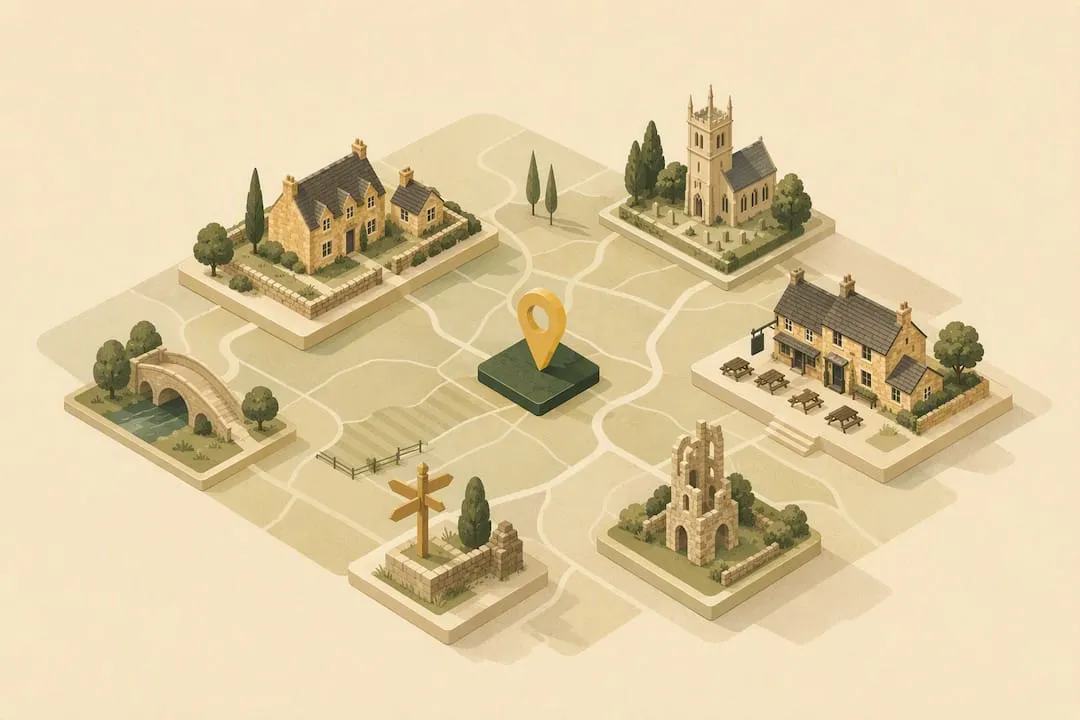
If you want to explore the Cotswolds rather than book a tour, a regional guide suits the job better than a global activity marketplace such as Viator. A marketplace lists bookable experiences across hundreds of destinations. A regional guide helps you find real places in one area — villages, pubs, walks, farm shops, gardens — and plan a day around them. Most of the Cotswolds' best days out involve nothing you can book at all. The Cotswolds App is one such guide, and this article explains what it does and does not do.
TL;DR:
- Tour marketplaces are built to sell bookable slots. Regional guides are built to help you find places, most of which never take an online booking.
- In a rural region, the features that matter are a good map, an offline copy for when signal drops, and honest ratings from visitors.
- Treat opening hours on any app as a guide, and check directly with small venues before you travel.
- The Cotswolds App is free, maps thousands of places, and takes no booking commission.
Table of Contents
- What is a regional discovery directory, and how does it differ from Viator?
- What features should a good regional discovery app have?
- How do you use a regional app to plan and navigate a trip?
- The Cotswolds App: a working example of regional discovery
- How do the leading alternatives compare?
- What do these alternatives cost, and how do they make money?
- Will you find niche or unusual experiences on these apps?
- How do mobile usability and offline features stack up across alternatives?
- What about customer support and cancellation policies?
- Why regional discovery apps matter
- Try The Cotswolds App for your next regional trip
What is a regional discovery directory, and how does it differ from Viator?
A regional guide does one job: it helps you find and plan visits to real places within a defined area. A global activity marketplace does a different job. It lists bookable experiences at scale, with a transaction at the end of every search.
That difference changes what you see. A marketplace can only show what can be booked through it. A honey-stone tearoom that has never taken an online booking, a church with a fine brass, or a footpath to a viewpoint will never appear there, but it can sit on a regional map with directions and ratings from people who went.
Using a regional guide usually runs like this:
- Discover: browse by area or category, or search for a place by name.
- Read: check the description, ratings, photos and opening details.
- Plan: save the places you like and work out how they fit into a day.
- Check: confirm opening times with the venue before you set off.
What features should a good regional discovery app have?
Some of these sound obvious, but they separate a useful guide from a list of names.
- A map that works offline. Rural valleys lose signal quickly, so being able to download the map and listings in advance matters more here than in a city.
- Clear listing pages. Address, opening hours, website and phone number should be easy to find on every place.
- Ratings from real visitors. Look at how many people rated a place and how recently. One old rating tells you little.
- Browsing by category and area. Being able to see just the pubs, or just the walks, near where you are saves scrolling past everything else.
- Planning tools. Somewhere to save the places you want and see how far apart they are.
Pro Tip: Treat opening hours on any app or website as provisional for small independent venues, which change them more often than chains. A quick call the day before saves a wasted journey.
How do you use a regional app to plan and navigate a trip?
Start with the kind of day you want — a walk, a food-led afternoon, a family outing — rather than a blank map. Then:
- shortlist three or four places in one small area, rather than across the whole region;
- check realistic travel times between them, not the straight-line distance;
- download the area before you leave if you expect patchy signal;
- confirm opening times directly with small venues;
- save the plan and share it with whoever you are travelling with.
Travel time is where plans usually go wrong. A pub lunch, a walk to a viewpoint and a stop on the way home can fill an afternoon if the distances are longer than they looked. In The Cotswolds App, saving stops into an itinerary shows the driving route and time between them.
The Cotswolds App: a working example of regional discovery
The Cotswolds App maps thousands of places across the region, from villages and walks to pubs, farm shops and gardens. What it does:
- Map and directory: browse by category or group, search by name, or show places within a set distance of where you are.
- Place pages: address, opening hours where we hold them, and visitor ratings, including accessibility and dog-friendly scores where people have left them.
- Area guides: pages such as Things to do around Avening group what is near a village. Their place listings update as the directory does.
- Itineraries: save stops, group them by day, and see the driving route between them.
- Offline: signed-in users can download the directory and map to use without signal.
Where the listings come from matters for how far to trust them. Most start from open data — OpenStreetMap, Overture and Foursquare — and nothing is published automatically: every place goes in as a draft and appears only after review. Ratings come from visitors, not a data feed. Some details will still be out of date, which is why checking directly with small venues is worth the minute it takes.
How do the leading alternatives compare?
Tools for finding places tend to fall into three kinds.
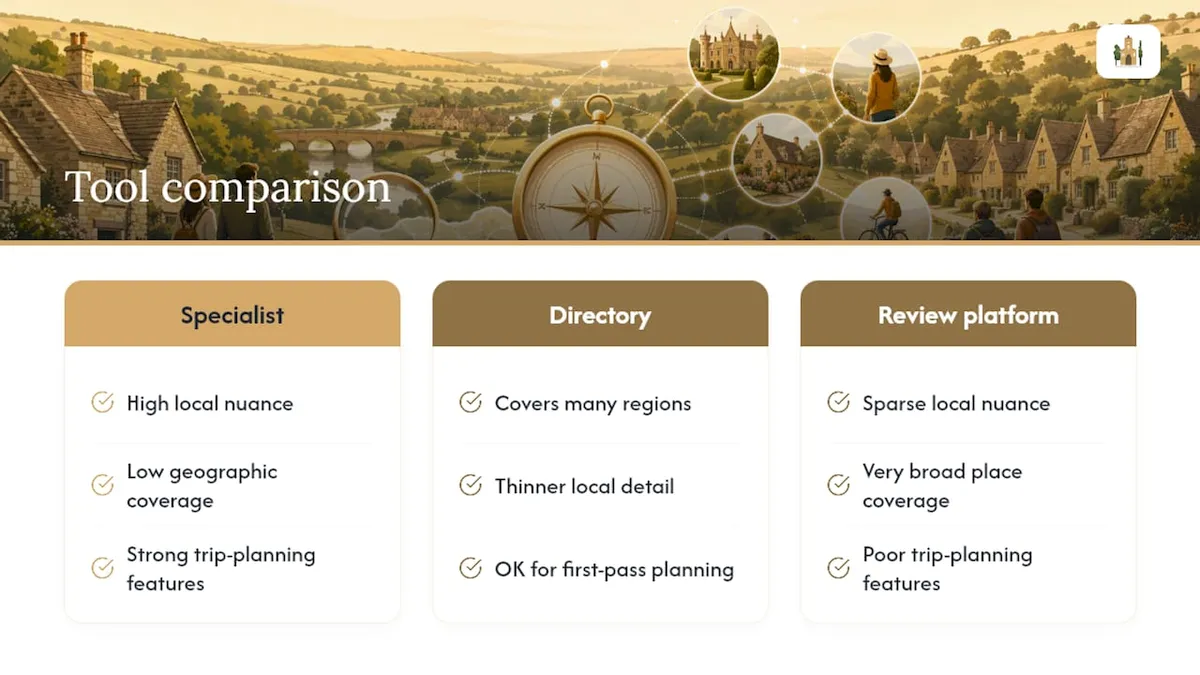
Single-region guides go deep rather than wide: more places in one area, and local detail such as parking or seasonal opening. The trade-off is coverage; if your trip spans several regions, you will need more than one.
Multi-region directories cover more ground, but the local detail usually thins out as they scale.
Review platforms are useful for a quick check on a restaurant, but are rarely built around planning a day, working offline or grouping places by area.
Match the tool to the trip. One rural region with plenty to see calls for a specialist guide. A tour across several regions may justify a broader directory.
What do these alternatives cost, and how do they make money?
Many regional guides are free to use. Before you rely on one, it is worth asking how it pays for itself, because that shapes what it shows you. A marketplace earns commission on bookings, so its incentive is to move you towards checkout.
The Cotswolds App is free. It takes no booking commission, and businesses do not pay to be listed or to claim their listing. The places featured on the home page are picked by us, not bought.
Will you find niche or unusual experiences on these apps?
This is where a regional guide has the clearest advantage. A pottery that opens two days a week, a farm shop down a lane, or a wildflower meadow reached by footpath does not fit a bookable-tour format, but each can sit on a regional map with a description and directions.

The trade-off is that small places change without telling anyone. A venue with no online presence may have new hours, or have closed, before any directory hears about it. Ratings from recent visitors are the best early warning, so it helps when people leave them.
How do mobile usability and offline features stack up across alternatives?
Offline access matters more than anything else in a rural region. Signal drops between villages, and an app that needs a live connection stops working exactly when you need it. Check before you travel whether an app lets you download maps and listings in advance, and do it on your home wifi rather than a patchy rural connection.
In The Cotswolds App, signed-in users can download the directory, the map tiles and the place photos from the storage page in their account, choosing the whole region or just the area near them.
What about customer support and cancellation policies?
When you book through a marketplace, the marketplace is part of the transaction, so its support desk and refund terms apply. When a regional guide simply points you to a venue, there is no transaction in the app at all: any booking, and its cancellation terms, is between you and the venue. Check those terms with the venue directly.
The Cotswolds App does not take bookings or payments. If a listing is wrong, you can suggest an edit from the place page, and a business can claim its listing to correct its own details.
Why regional discovery apps matter
Marketplaces favour what can be sold at scale. A regional guide can give the same space to a village tearoom as to a stately home, which suits a region whose character lies in small places.
For local businesses, the most useful thing you control is accuracy. Keep your opening hours and photos current, and correct anything wrong on your listing. It costs almost nothing and does more for visitors' trust than any amount of polished copy.
Try The Cotswolds App for your next regional trip
The Cotswolds App is free and needs no account to browse.
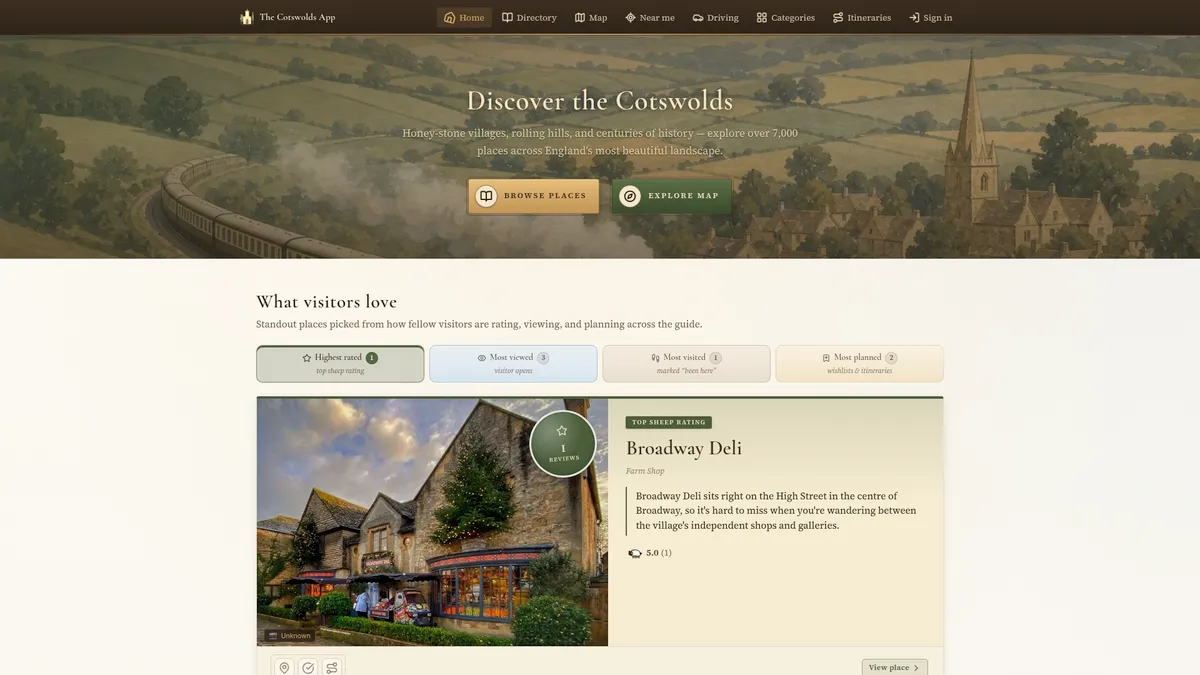
Start from the interactive map, browse the area guides by village, or look at Top Cotswolds Attractions for somewhere to start. Then install the app so your plan is on your phone before you set off.